Monday, October 31, 2011

HAPPY HALLOWEEN


The Japanese welcome any excuse to dress up in costumes, which makes Halloween perhaps the greatest cultural import since baseball.  This year I journeyed to Osaka to partake in my first Japanese Halloween.  Our plan was to meet up with some other people and then hang out at a bar until the first train out at 5:15 am.  Other than making the train, nothing else seemed to go to plan, and the night had elements of a classic buddy movie: strange characters, brushes with gangsters, crazy coincidences, and a trip to a fast food joint.

After a quick dinner, we went in search of the JETs at a bar.  One drink turned into many, and in that time period, most of the JETs had wandered off, and we found ourselves talking to a Japanese man and his two kids, ages 5 and 7 (yes, he had brought his children to a bar).  Also present was an expat from Louisiana, who immediately cottoned to me as a fellow southerner.  As we chatted, it came to light that he used to date my 7th grade English teacher.  Just another day in Japan.

The bar was eventually abandoned as we moved out to wander the trendy areas of Osaka in search of some people watching.  Oh, what a spectacle!  I regret I did not take more pictures.  Vegetables, boxers, bananas in pajamas, Muammar Gaddafi, Ronald McDonald, sexy cops, sexy flight attendants, men in drag, anime characters, and all sorts of gore-encrusted creatures roamed the streets.  Traffic was tight with the tricked-out Cadillacs of the yakuza (Japanese gangsters) cruising by.  People caroused, staggered drunkenly, and stopped every 5-10 ft. to take photos with strangers.  However, as the night wore on, the revelers started to flag, falling asleep in cafes, and sitting in exhausted huddles on the pavement and in the parks.  The witching hour had passed, and we were now all sitting pumpkins.

Yakuza hanging out
The evening culminated in a visit to a purgatorial McDonalds, where we waited with the dregs of Halloween humanity from 3:30 am until the subway opened at 5 am.  Luckily, the time passed quickly, thanks to a JET whose company we had acquired at the bar earlier in the evening.  The individual in question knows how to have a good time, and not wanting to abandon him in his state, we led him by the hand through Osaka, trying to keep him awake and vertical.  The effort was well worth it, as he greatly entertained us, zoning in and out of the conversation with every passing scantily clad Japanese girl, a look of joy and wonderment lighting up his face each time.  

The McDonald's crew was an interesting cross-section, from the homeless, to numerous elderly people, to gaijin like us, to Japanese youths. Makeup was starting to run, and wigs were askew. Some people were dead asleep among their hamburger wrappers and empty cups, while others clearly had no intention of purchasing anything, but were determined to camp out anyway.  A few patrons were carried in, completely passed out.  But at 4:45 am, everyone was galvanized into action and made a break for the train station, and eventually, our beds.   Happy Halloween, all.
Everyone is welcome at the Golden Arches
GIVE ME A BREAK

My third years are starting on their big project of the trimester, making their own advertisement and presenting it in front of the class.  As an example, I brought in a KitKat bar and did the old jingle, "Give me a break, give me a break...break me off a piece of that KitKat bar!"  Later, the JTE told me, "Did you know that in Japan, students consider KitKats lucky?"  "KitKat," it turns out, is remarkably similar to a Japanese saying, Kitto-katsu, or "I know you will win!"  During exam time, students squirrel away packages of KitKats as brain food and good luck charms.  We're still awaiting the results of the research trials to confirm this theory.

Cookies and cream
Back in the olden days, the only KitKat flavor that existed was milk chocolate.  Now the brand has gotten fancy, and introduced a whole host of flavors, which seemed to be geared mainly towards the Japanese market, with flavors like green tea, cherry blossom, wasabi and soy sauce.  Since learning of this flavor diversification, I've found an additional purpose in Japan: to try as many varieties of KitKats as possible.  
"Dark cookies"
IT'S IN THE BLOOD

One of my third years ran up to me after class last week and asked what my blood type is. I asked the JTE about it later.

JTE: Oh, they saw your drawings on the board [which were horrifically terrible]. In Japan we think that people who have type O blood are [?]
Me: What is [?]
JTE: Oh, it means...not nervous. Big heart.

Unfortunately, I think I might have type A blood. So I guess this means I’m just a bad artist.

This encounter got me thinking.  On Facebook, many Japanese people have their blood type listed, which seemed quirky, but I assumed had some practical purpose.  So I turned to that incontrovertible source, the Internet.  It yielded the following information: geneticists of the Third Reich examined blood type as a possible indicator of personality.  Somehow this caught on in Japan, and it has become a huge fad, like horoscopes were in the 70s.  Politicians and celebrities list blood type among their stats, along with birth date and hometown.  Blood type is also used in matchmaking services and job applications, and TV programs provide a daily blood horoscope.  On the downside, this pseudo-scientific classification of people has led to instances of discrimination, not to mention bullying at school (which is called bura-hara when related to blood type). Should you desire more insight into your own personality, I provide below a chart for your reference.  


Type A
Best traitsEarnest, creative, sensible, reserved, patient, responsible
Worst traitsFastidious, overearnest, stubborn, tense
Type B
Best traitsWild, active, doer, creative, passionate, strong
Worst traitsSelfish, irresponsible, unforgiving, unpredictable
Type AB
Best traitsCool, controlled, rational, sociable, adaptable
Worst traitsCritical, indecisive, forgetful, irresponsible, "split personality"
Type O
Best traitsAgreeable, sociable, optimistic
Worst traitsVain, rude, jealous, arrogant

Monday, October 24, 2011

HIROSHIMA, JAPAN

I admit, I was a little wary as an American to visit Hiroshima.  In a world where people from foreign nations still hold George W. Bush against us, I couldn't imagine what it would be like to walk around a city that my country (along with a few others) destroyed.  However, it proved to be a great trip, and I can confidently say that Hiroshima is my favorite place in Japan so far.

I took the night bus, which put me in Hiroshima around 6AM.  I bounded off the bus surprisingly rested, checked into a hostel when it opened at 8AM, and then grabbed my camera and headed to Miyajima.  Miyajima is an island about an hour from Hiroshima proper.  It's famous for its torii gate, which at high tide looks as though it's floating on the sea.    This view is considered one of the three most beautiful in Japan.  However, Miyajima has a great deal more to offer than just the torii gate.   It is also the site of a beautiful shrine suspended over the sea, as well as Mt. Misen, which is considered a holy mountain.  If you make the arduous hike to the top, there's a breathtaking view of Hiroshima and the surrounding islands, including Shikoku, one of the main islands of Japan. 


Torii gate

Itsukushima Shrine

View from Mt. Misen
GALLANTRY, THY NAME IS MAYU-AKI-YUKI-SAE-ETC.

Here's the story of how I was rescued from either mauling or murder by half a dozen nine year-old Japanese girls.  

I've detailed in previous posts my clashes with the deer of Nara.  Alas, Miyajima proved to be no haven from this scourge.  I was sitting by the sea, savoring the Goldfish my mother had exported from the States to Japan, when a hungry deer came my way.  As I attempted to shield my precious Goldfish from the deer with my body, he/she/it took offense, and starting rooting around in my backpack, which was sitting next to me.  I wasn't terribly concerned until I realized that the deer had sniffed out the sembei (crackers) I had just bought 10 minutes earlier to bring back to the teachers at my school.  It pulled out the bag, and quickly and efficiently shredded it, causing crackers to fly everywhere.  The deer then proceeded to calmly munch on the fallen snacks.

It all happened so fast.  By the time I stood up, it was over.  All I could do was mutter repeatedly sotto voce various dark epithets.  I quickly realized there was nothing that could be done to remedy the situation.  My mind then turned to what I should do in retaliation.  Push the deer into the sea?  It could probably swim.  Let it choke on the plastic bag?  Not even my cold cold heart could countenance that.  My ruminations were cut short by the entrance of a gaggle of young Japanese girls, who had been watching the spectacle in frozen horror.  They immediately took charge, grabbing the plastic away from the deer, collecting the ruined crackers from the ground, and then forming a ring around the deer and herding it away from me (by this time the deer had started to eye my Goldfish again and was making its way towards me).  They brushed off the crackers one by one, and handed them to me with bowed heads, saying, "Sumimasen," which translates roughly as, "Excuse me."  Their intervention was enough to diffuse the situation, and I thanked them profusely and then walked away, giving the evil eye to the deer, who had lost interest once all recognizable food sources disappeared.  

One of my antagonist's brethren. I'm still bitter.

DON'T EAT THE PICTURES

The city of Hiroshima has built a sizable peace park, which includes a very balanced and informative museum.  It traces the history of Hiroshima from a growing port to a strategic location for the Japanese army, with a barracks and training ground for an army regiment during the Sino-Japanese and Russo-Japanese wars.  Eventually, this made Hiroshima a prime target for the Allies.  However, what I did not know, but learned at the museum, was that Hiroshima was essentially chosen over Niigata and other considered cities because it was the one area where no POWs were being held.  The Allies chose Japan over Germany to test the bomb, because they figured that if the bomb didn't detonate, the Japanese would have a harder time appropriating the bomb's technology than the Germans (who, as you history buffs may remember, were developing their own atomic weapon).  The final straw was that the US in particular was eager to bring about an end to the war.  America feared the growing power of the Soviet Union, and wanted to end the war before Stalin did something Stalin-esque, like invade and occupy Japan.

And so, the bomb was dropped on August 6, 1945.  Photos of the city taken a month later show little more than rubble, save for a few remaining structures, such as a building now called the A-bomb dome (even more remarkable considering that Little Boy detonated a few hundred meters from the structure).  The museum has case after case of artifacts from the surrounding area: glass and pottery that melted together from the heat and radiation; metal lunch boxes that survived intact, housing the ashy remains of a lunch that was never eaten; the clothes of children of various ages, ripped apart and clearly displaying stains I'd rather not think too much about.  Then there are the photos.  Most people within the immediate blast area died within a few days, in excruciating pain.  Yet there were others who lingered.  The photos of their burns are surreal- it's like looking at a petrified person from Pompeii.  Then you're taken through the aftermath of the bomb: the different kinds of cancers, the burn scars, the instances of birth defects and mental retardation found in children years later, etc. 
Post-bombing
A-bomb dome today.  At the bottom of the photo are a bunch of elementary school students.  Hiroshima is a popular field trip destination, like Washington, DC is for Americans.

The museum closes with its propaganda against the continued existence of and military exercises with nuclear weapons.  There are photos of various dignitaries who have visited the city, from Mother Teresa to Pope John Paul II to members of the G8 to various presidents and prime ministers from the former Soviet Union.  Copies of letters written by the mayor of Hiroshima to every sitting U.S. president since the war line the walls. 

I think what surprised me the most about Hiroshima in general is their capacity for forgiveness.  There are no recriminations, no lingering hatred of the West.  Instead, the message is: let this never happen anywhere, to anyone, ever again.   
Paper cranes.  The sheer volume of these offerings at the different monuments is staggering.  Cranes represent longevity, but they also relate to the story of a young girl from Hiroshima who developed leukemia at age 11.  She thought that if she could fold 1,000 cranes, she would survive. When children visit Hiroshima, they make garlands of these cranes to leave at the Childrens' Memorial.
(As a side note, amongst the many monuments in the peace park, there is one memorial to the Korean victims of the bomb.  Thousands of Chinese and Korean people were forcibly brought to Japan as slave labor during WWII.  A great number of them were sent to Hiroshima and died in the blast.)   

Sunday, October 16, 2011

HOOK 'EM HORNS

Of its many attractions, Nara is perhaps most renowned for its sacred deer (population 1200).  With no predators in sight, the deer run this town.  They cross busy roads with nonchalant abandon, confident that the motorists will stop for them.  They sidle up to tourists in the hope that someone will feed them.  They cluster around the little carts that sell sembei, or crackers, which are then fed to the deer.    The deer have even been trained to bow to tourists, a neat and endearing trick that often results in more sembei.  

For the past 300 years, Nara City has held a ceremony in the autumn in which Shinto priests capture male deer and remove their horns.  Traditionally, this was to prevent the deer from harming one another when sparring during mating season, as well as a means of preserving the trees in the park as the deer became more aggressive.  Now it's also a measure of protection for the tourists, who think of Nara as a giant petting zoo and disregard the fact that these are in fact wild animals (despite the civility of the deer as they bow for sembei).  There are large signs throughout the park warning visitors that the deer will "bite, butt, kick and knock down" people. Still, there are casualties every year. I learned the hard way that the deer are not to be trusted or pitied. A while back I was nearly trampled by a herd as I attempted to feed them crackers (they looked so pitiful!).   They descended upon me like a group of velociraptors- you have your sights fixed on the horde milling around you, when the she deer comes out of nowhere and bites you in the butt.
But I digress.  The process of the removal of the antlers is akin to a rodeo.  Three deer are let into a closed pen, followed by 10-15 men, some of whom are carrying Japanese lassos- bamboo lashed together into a square shape and tied to a long rope.  The lasso is thrown out, and if all goes well, the antlers get caught in the bamboo, and the deer is pulled in.  Meanwhile, 4-5 men set up a wall of fabric blocking off the caught deer from the sight of the other two.  Kind of like when the dentist takes you into another room before pulling out your teeth.

One brave man pins the captured deer to the ground as the others help.  Once the deer is immobilized, it is gently carried to a straw pallet, which has been unfurled on the ground.  The men lay the deer on the pallet, placing its head on a fluffy pillow.  A priest in a black mitre-like hat comes out, dribbles a little water from a tea pot into the deer's mouth "to calm it," and then takes out a hand saw and gently and deftly removes the horns.  When it's over, the men let go of the deer, and it runs off into a separate pen.  Painless. As you leave, you can pay 100 yen to have your picture taken with the sawed-off horns.  Some restaurants in the area even serve soups with shaved deer horn, or fry slivers into chips.


It's a good racket. The deer are well cared for, and the city makes a mint off of deer memorabilia.  Key chains, hand puppets, stuffed animals, postcards, tshirts, bags, hats, etc.  And let's not forget Sento-kun, Nara's mascot.  Each area in Japan has a mascot.  Nara chose a baby in a sarong with deer antlers. 
Sento-kun's GQ spread
Sento-kun and family: a portrait of creepiness.  This unnerved me more than anything I've seen in Japan so far.  At first I thought they were all dolls dressed up as different members of Sento-kun's family.  Negative.  If you look closely, they are actually humans dressed up as dolls dressed up as Sento-kun's family.

RUN, SHINJO, RUN
In schools across Japan, academia screeches to a halt for one or two October days for the commemoration of Sports Day.  What it commemorates, I'm not sure.  Athletic prowess? School unity? Nice weather? Pick a reason.  Regardless, it's taken very seriously and provides a two day break from classes: one day to practice, the other for the competition.  Sports day proper begins with an assembly on the field.  The school band plays marching music, and the various classes march by in lock step, chanting "Ichi ni, Ichi ni" or "One two, one two."  The students troop by and salute the principal (who was standing, appropriately, on a raised platform with a microphone).

The events are mostly what you would expect: relays, races of various distances around the track, tug of war, etc.  Then there are the wild cards, like the game where a male student must run 10 yards to where a group of his classmates are holding steady a long bamboo pole in a pose reminiscent of the raising of the American flag at Iwo Jima.  He then literally jumps onto the backs of his teammates, shimmies up the pole, and places a flag at the top.  He jumps down, and the next boy in line repeats the process, except he takes down the flag that the first boy planted.  This goes on and on until every team is done (and the backs of the bamboo crew are broken).  

In another game, the girls take to opposite ends of the field.  When the starter pistol is fired, they run to the center, where there are more bamboo poles lying on the ground.  The girls try to bring back as many poles as they can for a win.  The desire to win is palpable, and I watched many a young girl being dragged by a gang of classmates across the dirt.  It had the makings of a scene from The Hunger Games. As for me, I was heartily glad to be out of the fray.  Indeed, I was well taken care of.  At seventy degrees with a vigorous breeze, it was a bit chilly for me, the cold-blooded one.  A student, chagrined at my perceived discomfort (goosebumps), immediately came over and started rubbing her hands up and down my arms to make me warmer.  Cue theme music to "To Catch a Predator."

Lest you think that I simply sat on my bum all day, I will mention that I did participate in two races.  One was a relay race with a bunch of the other "young" teachers against the students, which we lost.  Badly.  The second involved the students running a quarter of the track and then picking up a big card with the name of a teacher and a task.  They then had to go find the teacher, and run another quarter of the track with that teacher while skipping, running a three-legged race, holding hands and twirling in a circle, etc.  One of the teachers had to pick up a student and run with him across the finish line, like Kevin Costner and Whitney Houston in The Bodyguard.  As for me, Daniel and I held the hands of a first year student as we ran pellmell. Happily, we quickly passed the other contestants and our student won first place.  As we crossed the finish line, I couldn't help flinging my hands up in the air in victory.  This is, after all, probably the closest I will ever come to running in an actual race.

Monday, October 10, 2011

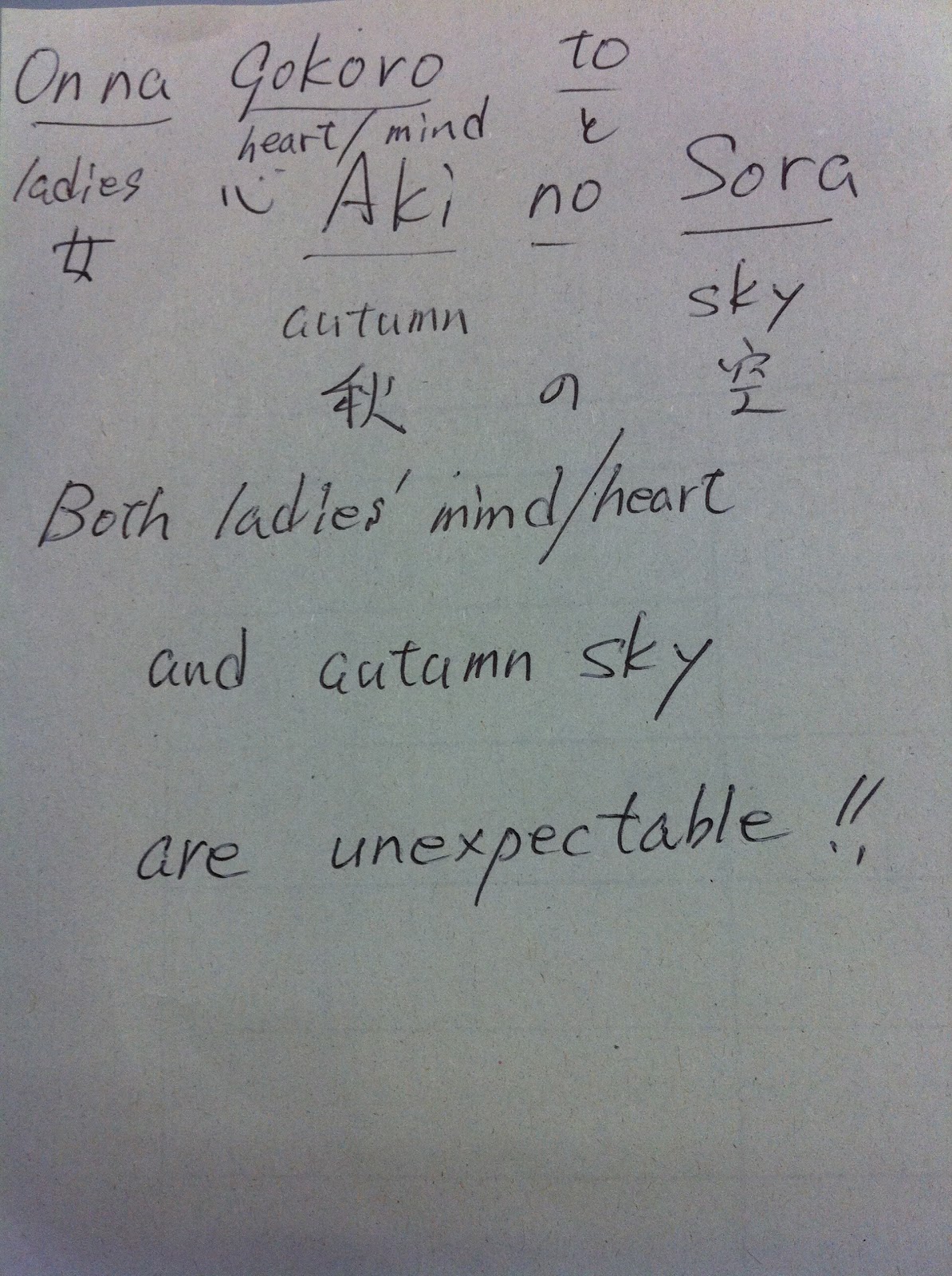
Onna gokoro to aki no sora: "A woman's heart/mind and the autumn sky are unpredictable!"


In an attempt to broaden my Japanese education, one of my JTEs left this charming saying on my desk. Believe it or not, I don't think it was a pointed statement about me. 
A lot of people (OK, two people, but theirs is the only feedback I've gotten) seem to want to hear more about "how the teaching is going."  For those of you who aren't interested in my long spiel, I'll sum it up quickly, and you can skip to the next section.  Basically:   In many respects, this is the hardest job I have ever had.  Which is not to discount my former jobs, all of which were demanding (Dragon Lady, I'm thinking of you) and instructive in their own ways.  Teaching, however, provides a unique set of challenges. 

No matter how smart, educated, hardworking or entertaining you are, none of those things alone means that you will be a good teacher.  In fact, if you are like me, there are many, many days when you think, "Wow, I am spectacularly bad at this."  My aunt recently wrote me and said, "Simple is good.  If they only learn 2 things from you a week, you are doing well."  She's right, of course.  But it's hard to not feel that those are low standards, when what the liberal in me really wants is a To Sir, With Love moment where all my students magically show up to school one day speaking in posh English, with jobs and life goals, referring to each other as "Miss Yamamoto" or "Mr. Matsuda."  A musical number would be nice, too.
Excerpt from a student's homework last week.  Under "What kind of music do you like?" she wrote, "I like soul music because I like the husky voice of a black person."
My biggest challenge is trying to figure out what the students' level of English proficiency is.  For four days, I did the same lesson over and over, elaborately explaining what a credit card is (they really aren't used here in Japan).  On the fifth day, the JTE for that class piped up and said, "Um, they know what a credit card is."  Which made me feel like a jerk, because it seemed as though I had been patronizing them for five minutes while wildly pantomiming swiping a credit card and signing for a purchase.

On the other hand, I might say, "There are 100 cents in a dollar.  If a quarter is worth 25 cents, or 1/4, how many quarters make a dollar?"  I then write a quasi-algebraic equation on the board to illustrate what I'm asking, and they still have no clue what is going on.  Interestingly, the hardest thing to get them to do is guess something.  I asked my first years to guess how many yen were in one dollar.  "Guess any number," I told them.  Crickets.  I wrote on the board, ___?____ yen = $1.  More silence.  I called on students, asking them to tell me a number.  Nuh uh.  Are they just shy, or intractable?  It's hard to tell. 
More homework.  "What are you interested in?"  Response: "I'm interested in liquor because my parents say 'It is very yummy,' so I [want to] drink liquor."  A future leader of Japan, no doubt.
In most professions, it's widely believed that if you work hard and prepare in advance, you will be successful.  In teaching, there are no such guarantees.  It's a bit like being a standup comedian in that your painstakingly thought out material (your lesson plan) could (and often does) completely bomb.   This isn't always the teacher's fault.  You can't predict that your kids will have been given a particularly grueling workout in PE the period before, or that some of them are so tired they become narcoleptic at their desks.  It's also difficult to know how advanced your lesson is until you try it out on an audience.  Even though the JTEs review all my lesson plans before class, there are inevitably classes that sit there and stare at you blankly when you ask them, "What did you eat for lunch today?" [Learning how to work with the different teaching styles of the JTEs is an entire post in and of itself.]

Often you can see the trainwreck before it hits,  You'll be giving directions about how to do something, and as you're speaking, the gaps and loopholes start becoming clear.  "Write your NAME on your paper." OK, I'm about to receive 20+ papers with the names written in Kanji. "Please write your name IN ENGLISH, NOT JAPANESE." "Here are some sample questions that you might be asked on the test."  Whoops, they think that these are the only questions that I'm going to ask them.  "The questions on the handout are SAMPLE questions. They are EXAMPLES.  I will ask you DIFFERENT questions on the test, so please study ALL the material."  Thus, I'm convinced that improvisation is the watchword of good teaching.  You thought that explanation was simple, but the students are cocking their heads to the side the way your dog does when you lay out a three-minute rationale for why you want him to do something, and then realize he doesn't understand anything that doesn't involve "dinner," "go out," or "treat."  Therefore, you need to think of an alternate explanation...in two seconds.  The activity you thought would take 20 minutes just took 8. Add new conditions to the activity, or be ready to entertain them with a game. And when the rest of the class can't hear you over the magpie chatter of two unruly first-years, take the opportunity to diverge from your lesson plan and lay down the law about talking in class, impressively brandishing red cards over your head and telling them that the next person to speak out of turn will receive a red card and have points taken off their grade.  And that would make you so sad. Boo hoo.

All this is really just to say that the teaching is going fine.  It's an uphill battle, but so rewarding when students ace a worksheet or a quiz, or laugh at a goofy joke I made (my physical comedy skills are really making leaps and bounds).  It's also nice that no matter how bored they were in class, or how badly I think I did that period, the students don't hold it against me in the halls, and still greet me with choruses of, "ERI-SENSEI! HELLO! IAMFINETHANKYOUHOWAREYOUUUUU?!" 

I HAVE A FEELING WE'RE NOT IN KANSAS ANYMORE
This next story takes us deep into the seedy underbelly of Japan.

All right, that was really just a ploy to get your attention.  Last weekend I attended my first Japanese baseball game, and afterwards explored Osaka at night with a group of friends.  On our itinerary: visit a maid cafe.  Maid cafes, if you're unfamiliar, are restaurants where (usually men) go to be served food and drinks by cute, young girls in frilly maid outfits.  It's a fetish thing, but there are no sexual favors involved.  Depending on what kind of restaurant you go to, the maids can be really eager and sweet, or kind of mean to you at first, and then sweet and charming as you're leaving, trying to get you to stay.  Maid cafe spin offs include "butler cafes," "Mom cafes," where older, matronly women scold and nag and listen to your problems, and "little sister" cafes, where again, young, sweet things wait on you and call you "older brother."  That one is the creepiest.

We arrive at MaiDreamin', a cafe recommended by a second-year JET BL, and are welcomed inside after being told that we all have to keep our hands to ourselves. NO TOUCHING of the maids.  Nor are we allowed to take photos inside, unless we want to pay an extra $5 per person to have a Polaroid taken with our waitress.  Our party consists of me, a married couple, and three other friends, two of them male, one of them female.  The place is full and so small that we have to sit at separate tables: our married friends at one, the rest of us at another.  A maid comes over, introduces herself on her hands and knees, and pulls out a small electric candle.  She tells us that when the candle is lit, the girls will become princesses, and the boys will become masters.  We count to three, the candle is lit, and our night of magic begins.

The menu is ridiculously overpriced.  Most of the meals come in sets: mediocre food on which the maid comes by and draws a heart or an animal face.  There is also a drink menu where if you order off a certain section, a maid will come to your table and mix your drink in front of you, while saying your name over and over.  I watched a gentleman who requested this service, and he was far too transfixed by the rhythmic repetition of his name for it to be proper.  When the maid serves your food, you're required to chant something in Japanese with her while making a heart shape with your hands.  I can't remember what it translates to, but it has something to do with blushing. I think.
An example of maid couture from www.cryosites.com

What I loved about the evening was that the girls were able to enjoy it for what it was: a completely bizarre, surreal cultural experience.  We embraced the discomfort, and reveled in it.  The guys, on the other hand, were practically crawling out of their skins with mortification, and couldn't wait to bolt out of there.  The turnover of the tables is quick (there's a 500 yen per person surcharge for the first hour, and then you have to pay more per person per hour subsequently- this is a racket).  To protect our wallets and the delicate sensibilities of the menfolk, we escaped after about an hour.  Because of the cost (and the weirdness), I'm not sure I'd go back to a maid cafe, but it's one thing off the Japanese bucket list!

Tuesday, September 27, 2011

NOM NOM NOM NOM NOM

One of my pledges in coming to Japan was to eat as much as possible, and so far, I feel as though I'm making good use of my time.  Those of you who are friends with me on Facebook have probably seen the entire album I have dedicated to photos I've taken of things I've eaten or want to eat. (Drew and Pauline, I blame you for this sick compulsion.) For those of you who are not on Facebook and therefore haven't seen the photos, this blog post is for you.  I'm calling it "the food porn" entry.

In my next life, I will move someplace where I can eat a baguette, some sort of ripened cheese, and a charcuterie plate every day, accompanied by fruit, pickles and fresh vegetables.  However, that life is not this one.  This reality is filled with foodstuffs ranging from the glorious to "what the hell is that"?  I'm steadily becoming a pseudo-vegetarian, as meat is expensive, and vegetables are reasonably priced.  I became the envy of all my friends when I found a farmer's market near my school.  Once a week I go stock up on locally grown okra, potatoes, figs, carrots, onions, garlic, basil, eggplant and tomatoes.  As a result, I am ruined.  Gone are the days when I will go to the supermarket and pick up a genetically enhanced, watery, mealy tomato.  The very thought turns my stomach.  The paradise that is the farmers' market lacks only one thing: affordable fruit.  

Fruit is prohibitively expensive in Japan- $5 for one apple, close to $10 for a small cluster of grapes.   But oh, the flavor! Eating a grape is like tasting the richest, plummiest piece of grape candy imaginable.  A Japanese white peach is so delicious that you may have to put your head between yours knees because you start seeing rainbows.  This may sound hyperbolic, but I assure you, every word is true.  Except for maybe the rainbows.  All fruits are eaten peeled.  For example, the Japanese have invented a rather charming method of separating the flesh of grapes from their skins.  Simply bite off the top of the grape before gently using your teeth to juice the fruit (don't puncture the skin!), while simultaneously sucking on it until the grape pops out, leaving its shell behind. An easy way to fascinate (and possibly disgust) the Japanese is to pop an entire grape in your mouth, or chomp down on an unpeeled apple or peach.

MY TOP 5 FOOD MOMENTS...SO FAR
1. I make my own caviar.  I have long loved "ikura," which is a kind of sushi that involves red caviar.  Imagine my glee when I found a whole skein of roe at the local supermarket, begging me to take it home.  

So I caved to the impulse buy, and got to work.  First, I had to separate each individual piece of roe from the membrane.  I tried to do this by hand with a paring knife, only to realize that it could be Christmas before I finished.  So instead, I logged on to the miraculous world that is the Internet, and deferred to the wisdom of the foodies.  Following their instructions, I boiled some water, let it cool a touch, and then submerged the skein for a few minutes.  I then removed the skein and easily pulled away the bits of membrane, revealing perfect little jeweled globes of roe.  

Victory! I thought.  I made my sushi rice.  I unfurled my nori (dried seaweed used in sushi).  I sat down, and took my first bite...of disgusting fishy fluid.  DISASTER. Had the roe expired? Did I do something wrong?  I again sought solace and answers in the Internet, and realized that I had skipped a crucial step: you have to brine the roe in order to make caviar.  So I made a warm saline solution, poured in the roe, and let it sit for half an hour.  Problem solved.

2. Two words: squid jerky (surume).  A friend was gifted a bag of "sweets," which she brought to share at a potluck.  Upon opening the bag, it soon became clear that the sweets were, in fact, various kinds of dried, salted squid.  However, refusal was not an option for this intrepid crew.  Each person manned a bag, and the snacking commenced. My conclusion: robust, maritime flavor given depth by aging.  I'm convinced there is a market for this product in the States. Let me know if you want a piece of this action.  We can brand it as healthy, as it is made of fish.

3. Black sesame ice cream. One hot day, I opted to cool down with some ice cream.  Ignoring the more conventional vanilla or chocolate, or even green tea or red bean, I elected to try the black sesame.  Slightly gritty in texture and taste, let's put this down as one of the things that Ben and Jerrys should not pick up as their new featured flavor (though "Black Sesame" does sound more appetizing than "Schweddy Balls"). 

4. Sushi.  I haven't eaten as much as one might expect, but the few times I have, it's been delicious.  I've enjoyed the greatest hits: yellowtail, salmon roe, various kinds of maki, salmon, octopus, eel, etc.  The most spectacular was toro (fatty tuna), which made me weak in the knees.  The worst was  seaweed with some sort of fish egg attached to it. I think it's safe to say that it was one of the more revolting things I've ever eaten- tasteless and of a hair-raising consistency, like something that had congealed and been put on rice.
The offending green sushi is middle right; toro is back center.
5. Goya, or bitter melon.  This vegetable is popular in Okinawa, and looks like I imagine a snozzcumber would, if Roald Dahl's book "The BFG" were to come to life.  Described by Dahl as "filthsome," that pretty much encompasses the taste of bitter melon, according to my sources.   Per instructions from knowledgeable Japanese acquaintances, I first cut the goya into small slices and salted them, squeezing out their juice in order to lessen the bitter flavor.  I then sauteed them in a pan with pieces of pork before adding soy sauce and a little rice vinegar.  The result? The vegetable was a little piquant, but not inedible.  I think it helped that the pan I sauteed them in was filled with drippings from bacon I had fried moments earlier.  

On a somewhat related tangent, I've slowly been making a few friends here.  We are united by our relatively advanced age, our sense of adventure, our love for traditional Japanese culture and experiences, but most of all, our obsession with food.   Our friendship was clinched when, ten minutes into a trip to Kyoto, I asked for us to detour across the busy street so I could take a photo of the Japanese branch of The Doughnut Plant for my doughnut pilgrimage compatriots from this spring.  The group willingly agreed, and instead of preparing to saunter on after the requisite photos had been taken, they suggested that we stop for a doughnut taste test.  What made this even more remarkable was the fact that we had met up not 45 minutes before for coffee and a pastry at the train station.  People who like to eat every 30 minutes to an hour? Kismet.
Four...doughnuteers?

Wednesday, September 21, 2011

WHEN IN ROME

Living in Japan, there's a cultural integration process.  Learning how to bow and when (10, 45 or 90 degrees), what to do with your shoes once you've removed them at an entrance (line them up neatly facing the door, so you can easily step into them when you depart), what form of "thank you" to use (present tense when someone is handing you something or in the middle of doing something for you, past tense after the action is completed), etc.  There are new gestures and body language to be assimilated.  Perhaps most confusing is the motion for "come here": extending the palm face down, then fanning the fingers in a move that we associate with shooing something or someone.  


My favorite gesture is "the shark fin."  When trying to move through crowds or past people, you bow at a 70 degree angle, with your hand held like a fin, which you then touch to your forehead as you move, muttering, "Sumimasen! Sumimasen!"

The shark fin at work
Conversely, here's a somewhat blurry photo of Western body language as decoded by an English textbook used in Japanese high schools:


As we all know, folding your hands over your abdomen with your elbows sticking out signifies "I'm bored."
Perhaps my greatest nemesis in everyday Japanese life is the trash.  There is nary a public trash bin for miles.  Furthermore, the Japanese trash collection system is as tortuous as the US tax code.  Rubbish is sorted into four basic categories: burnable (food scraps, paper, etc.); plastic; PET bottles, glass and aluminum; and bulk items, like broken crockery, old futons, piles of newspaper, etc.  It's difficult to know which bin certain materials go in, and to remember which days which things are picked up.  Burnable trash is picked up twice a week, recyclables twice a month.  Depending on how strict your local trash collection is, if you mis-sort your garbage, you can expect to find the bag returned to you in all its stinky shame.  The fabled bulk items day occurs maybe once a month; however, no one seems to know which day of the month it will be  Instead, it sneaks up on you like a surprise Christmas, with a mass exodus of old clothes, moldy blankets, and broken TVs and electronics.  If you miss it, you're forced to continue to hoard junk in your closets for another month plus.

Chart showing the different categories of trash, and which days they are to be picked up
If you're on time in Japan, you're late.  The Japanese make the most out of every minute of the day.  A Japanese acquaintance told me recently, "Let's meet at 6:40."  Not 6:30, not 6:45, but 6:40.  Or, more accurately, 6:35.  I showed up punctually at the predetermined time to find her waiting for me.  "I hope you have not been waiting long," I said politely.  "Oh, don't worry, I'm used to Americans being late," she replied.  Late, I thought.  I'm on time! Moral of the story: always show up 5 minutes early.  And even then, you'll probably find the Japanese person you're meeting waiting for you.


IT'S HOT UNDER THIS SPOTLIGHT
Small town life in Japan is pretty much like small town life anywhere.  Newcomers stick out, and everyone knows everything about everyone else's business.  If you bought toilet paper at the convenience store last night, one of your students heard about it from their sister's cousin's best friend's dog.  A JET friend who lives in a town 20 minutes away said to me recently, "I hear you ate peanuts for lunch last week."  I looked at her quizzically and she elaborated, "I'm friends with the woman at the post office, whose sister's daughter is a student teacher at your school."  The spies! They're everywhere!

Part of my self-intro lesson at school involves letting the kids ask me questions about myself, America, or anything that gets them talking.  Usually they ask what music I listen to and where do I want to visit in Japan, over and over again. However, one of my classes came up with:


Do you have a boyfriend? (A popular question in all my classes)
Why is purple your favorite color?
What other languages do you speak?
Is your hair color natural?*
Why did you want to be a teacher?

*They consider me a blonde here- huzzah! However misguided (or flat-out wrong) that may be, I'm looking forward to finally experiencing the perks of being towheaded.

On Friday, it happened.  After the seemingly obligatory "Do you have a boyfriend?," a female student asked the follow-up question of, "What kind of man do you like?"** I looked around the room in amazement to see one of my male students looking intently at me.  When I caught his eye, he immediately began wiggling his eyebrows at me in a suggestive manner.  Not to be outdone by a seventeen-year-old, I maintained eye contact while wiggling my eyebrows back.  I then ruined this moment of uncharacteristic aplomb by blushing deep crimson.


**One JET suggested later, "Choose someone older, manlier, and completely different from them in every way! Crush their dreams!"

Wednesday, September 14, 2011

THE STUDENTS ARE HERE! THE STUDENTS ARE HERE!

Term has officially started, and it's a lovely change to have students running amok in the halls.  I'm teaching 13 English conversation classes a week, each 50 min long.  Because the typhoon caused several days of classes to be canceled, I've only taught a handful of lessons, so it's difficult to get a bearing on what teaching will be like. So far, it hasn't been a huge success- students spend the period staring at me, only to look away quickly when I ask them a question.  But there have been no revolts or deaths, so I guess that's something. 


English curricula in Japan concentrate on speaking English, not on reading or writing it.  This was somewhat of a shock for me, considering that in American high schools and colleges, language students are typically expected to be able to at least write a paragraph in that language, if not a short essay.  Though Japanese schools start teaching English as early as kindergarten, the level of instruction doesn't progress very far.  For one thing, there is no systematic teaching of grammar (how pronouns work, conjugating verbs, etc.). Most of the high school students I've encountered speak in simple, declarative sentences: "I like soccer." "My favorite food is pasta." "I have 2 sisters."   Indeed, I've been told that it's not uncommon for the Japanese teachers of English to not actually be able to speak English, and spend the class speaking in Japanese. This forced the government to pass a law this year stating that English must be spoken in English classes the entire time, and that all Japanese teachers of English must undergo a proficiency test.  If you don't pass, you can find a new job.  (All the teachers at my school speak English well.  There are also a number of students who have incredible facility in English, usually because they have at least one parent who studied abroad in an English-speaking country, or studied it in school.)   


The line between me and the students is an interesting one.  There are three types of relationships I can discern.  First, Normal Sensei: these students treat me as any other teacher, and bow low to me in the hallways, or on the road to and from school.  They are also the least likely to talk or make eye contact with me.  They are respectful, but painfully shy. 


Then there's Be My Pet Elephant Sensei.  Many of the girls are far more familiar, and like to pet, examine and praise.  I had one girl offer me french fries on the condition that she be allowed to feed them to me like a greasy communion wafer.  Another randomly started playing with my hair, until I turned around to talk to her.  She blurted something out in Japanese, and refused to tell me what she had said until I appealed to another student, who replied, "She says you smell good."


Being a westerner, this feels a little creepy and more than a little wrong.  It probably would be by Japanese standards too if I were Japanese, but because I'm the "other," people seem to find this kind of behavior charming, as if this is just a part of the cultural exchange.  I mean, students in the West give teachers back rubs or sniff them for traces of perfume, lotion or deodorant all the time, right?  Right? (Those last two examples are true and happened to two JETs.)


The final kind of interaction I have with the students involves what I call "The Two-Way Mirror Look."  I'll catch sight of students staring at me in the hallways, eyes narrowed, like at an animal in the zoo, or some kind of looming threat.  The look is so intense that it's angry, and takes me aback.  When this happens, I stop and say loudly, "Hello! How are you?" The person's whole aspect changes.  They look shocked ("What?! She can see me? I'm not standing behind my force field of invisibility?"), and then a huge smile lights up their faces, "Hello!!!" they chirp back, "Iamfinethankyouhowareyouuuu?"
The Two-Way Mirror Look
What gets me about the Two-Way Mirror Look is that they never seem to see me staring back at them and register that they're being rude.  They're so engrossed in studying me, that they are oblivious to everything else.

BUNKASAI
Every fall, the schools in Japan hold bunkasai, or a school culture festival.  Students and various clubs perform dances, songs and skits, there are speeches by administrators, and each class takes on a project: decorating a classroom, selling food they've prepared, etc.

Our bunkasai lasted two days.  The highlights: kocho-sensei singing Sinatra's "My Way," a girl in a giant Pikachu costume, two boys kissing onstage, the boys of 2-6 dressing in drag and dancing (nothing entertains a Japanese audience like cross-dressing men), and eating a good 20 lbs of food a day.  Oh, and then there was the time when I got up onstage to perform with the ESS club.  There was singing.  There was choreographed dancing.  There was a lot of awkwardness.  They had chosen two songs; first, "Material Girl" by Madonna, and then (my ears bleed), "We're All in This Together" from High School Musical.  Having reached the august age of 26 without ever having seen the movie or heard one of its songs, I had hoped that the High School Musical craze had passed and that my HSM virginity would remain intact.  Alas, it was not to be.  We practiced 3 days a week, 3 hours a day, for 3 weeks.  As for the performance itself, suffice to say that several of the third year boys pointed and laughed at me. 


And that's all I have to say about that.