Wednesday, July 17, 2013

THE VIEW FROM THE TOP: CLIMBING FUJI-SAN

"He who climbs Mount Fuji is a wise man; he who climbs twice is a fool." -Japanese Proverb


Fuji-san in May
A Kiwi, an American, a Canadian and a South African set out to climb a mountain.  This sounds like the start of a bad joke, but it's actually the beginning of the tale of how I climbed Mt. Fuji.  Born of a last-minute decision to seize our final moments here and do something epic and memorable, summitting one of the most infamous symbols of Japan seemed like an adequate exercise of carpe diem.  We reasoned that we would always regret it if we didn't at least try.  And so, with lots of research but no physical training, we departed for Shizuoka prefecture, modern age pilgrims paying homage to a venerated icon.   

A LITTLE BACKGROUND

Fuji (or Fuji-san, as it's referred to in Japan) is an active volcano, its last eruption taking place in 1707.  Some scientists fear that another eruption is imminent, and that an earthquake could set off a chain reaction, culminating in an explosion and a possible national emergency.  These grim prognostications haven't deterred the thousands of visitors Fuji receives each year, however.  

A count by the Japanese government estimates that over 300,000 people climbed Fuji last year alone.  They predict that these numbers will rise exponentially this year, in response to Mt. Fuji being named a UNESCO World Heritage Site in June.  The window for safely climbing Fuji is very narrow, from July to August.  Ascending during the rainy season or colder months can be treacherous, and there have been deaths and serious accidents in the off season.  Thus, the mountain is highly congested with human traffic at the peak of summer.  Prospective hikers are warned about queues leading up the mountain, forcing people to wait.  However, local governments are concerned about other repercussions from Fuji's designation as a World Heritage Site as well.  

Although it's Fuji policy to "pack in, pack out" (whatever you bring with you onto the mountain, you take with you afterwards, including trash), many are worried that the influx of hikers will cause the mountain to become filled with trash and detritus.  There's also a concern that the trekkers will have an adverse impact on the trails, causing erosion and rock slides, as well as affecting wildlife and foliage.  To help cope, the park may ask for a 1,000 yen ($10) suggested donation to defray the costs of upkeep, etc.  Given the prominence of Fuji in Japanese cultural consciousness, its preservation is of the utmost importance. 

Fuji has long occupied a place of reverence in Japanese culture, and is the subject of countless works of art, including ukiyo-e (woodblock prints), paintings, and poetry.  Fuji is considered a holy place, and has been a destination for thousands of pilgrims for centuries.  Until about 1872, women were not allowed to set foot on Fuji, as females were excluded from sacred spots around the country.  Today there are four trails leading to the summit.  We opted for the shortest and most westward-accessible route, the Fujinomiya Trail.      
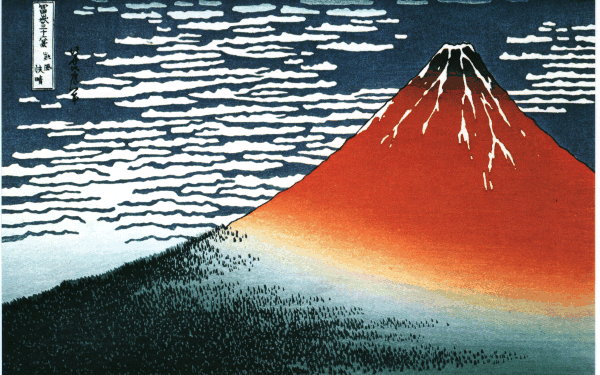
One of Hokusai's "Thirty-Six Views of Fuji." From commons.wikimedia.org.
NOW BACK TO OUR TALE

The Fujinomiya Trail is divided into sections, 1-10, with the summit being number 10.  We began at the 5th station, at 2,400 m.  For many, the point of climbing Fuji is to see the sunrise. Some choose to start from the 5th station and then sleep for a few hours at the 8th station before awakening around 1 or 2 am to start the final climb to the top.  However, we were among the dangan-tozan, or bullet climbers, people who try to make the sunrise by climbing through the night without resting.  We'd been advised that it would take approximately 6 hours for us to reach the top from the 5th station, and 3 hours to descend.  In the end, only 3 of the 4 of us made it to the summit.  One of us managed to make it up in 8.5 hours; two of us took 9.5 hours.  The descent was a whopping 5.5 hours, meaning that in total, we were on the move for almost 15 hours straight. 

Team FUJI at the 5th station.  Ah, look at the hope in those eyes!
As a dangan-tozan, your greatest enemy is not the altitude or the steepness of the trail or the crumbling terrain, or even the cold and wind.  The most difficult obstacle to overcome is fatigue.  We left the 5th station at 8 pm, meaning that the longest part of the climb, between stations 7-9, took place when we were supposed to be sleeping.  As my Kiwi companion put it: "My body is telling me I should be in my warm, comfortable bed right now."  Instead, we were toiling up a mountain in the pitch black, constantly buffeted by the rising winds, struggling to put one foot in front of the other.  I certainly fell asleep while standing up a few times, and any time we stopped to rest or catch our breaths, I'd drop off for a few minutes until it was time to move again.  

To be honest, I don't remember much about the hike up Fuji, I was so out of it.  The night was gorgeous.  The skies were perfectly clear, and the stars made an impressive, glimmering dome above us.  We saw at least one shooting star, and were mesmerized by the lights blanketing the valley below us.  You could distinguish the twist and turns of the trail from the head lamps of the various hikers, slowly wending their way up like ants up an anthill.  The effect was rather spooky; at times you felt as though you were in the throes of a zombie or science fiction film.

Our first big problem struck around station 7.5 (there are two station sevens, "old" and "new").  The vision of our South African team member started to blur, which initially we attributed to the fact that the wind was blowing tons of dirt and grit into our eyes.  However, it worsened the farther up she went, compounded by the fact that the batteries to her head lamp gave out, and she had to slowly pick her way over the rocks in the dark.  However, by the time we reached station 9.5, just a few hundred meters from the summit, she had lost sight in her left eye and couldn't go any farther, and she had to turn back.  Of all of us, she was the most brave in attempting to scale the mountain, and it was incredibly fortunate that she didn't fall or wander off the path.  But even more luckily, the damage to her eyesight wasn't permanent.  We later learned that she had become hypoxic, and that the altitude was preventing oxygen from getting to her eyes, altering her vision.  Thankfully her eyes returned to normal as she descended.

In between stations 8 and 9, I managed to do something to my right knee, that made it painful to bend.  Unfortunately, this kind of flexibility is required to move up a mountain, and is even more essential when going down again.  While I was able to manage the discomfort on the ascent, the descent was pretty grueling and painful.   


Almost to the summit.  Below you can see a huge tract of snow, and to the right, station 9.5.
And yet, despite all the odds, three of us made it to the top, at 3,776 m.  Only one of us made it up for the sunrise at 4:39 am; I and our Canadian team member followed at 5:30 am, after waiting in a queue of hikers for close to an hour.  The summit was cold and beautiful, and the view stunning. We paused for half an hour to explore, give thanks, and take some photos.  Then we took a deep breath, and started to make our way back down again, in the search of food and sleep. 
The summit.

The sunrise.
Finally made it to the summit, 3,776 m. 
Finally off the mountain almost 6 hours later, we made a hasty retreat back to civilization.  Each time I rubbed my eyes or my face in exhaustion, my fingers would come away with a fresh coating of black volcanic soil the mountain had baptized me in, and a full-body stiffness set in as soon as we stopped moving.  Days later, I still can't believe what we did.  Before I left, one of the grannies said to me, "If you can make it to the top, you will have success in the future!" As I gear up for the next chapter of my life, I can't help but hope that this is in fact a harbinger of things to come.  That with a lot of perseverance and a little team work, I'll manage to get where I want to be. 

TIPS FOR FUJI

If this narrative hasn't discouraged you from attempting to tackle Fuji, here are my recommendations based on my experience:

1. Don't be a hero.  Take constant stock of your mental and physical condition as you go up.  If you start feeling dizzy or nauseated, don't force yourself.  Take smaller steps, buy oxygen, and drink lots and lots and lots of water before, during and after.  If your vision becomes impaired or you vomit or lose your equilibrium, turn around and go back down.  The altitude sickness will only worsen as you go up, and you run the risk of doing serious damage to yourself and your health if you continue. 

On the Fujinomiya Trail, there is purportedly a first aid center at the 8th station.  However, when I asked about it, I was told that it wouldn't be open until the end of July.  Even if the center had been open, I can't speak to what sorts of services they would offer beyond bandaging things.  If you were injured to a point where you needed to get down the mountain quickly, I don't know that you would be able to be lifted off or driven down.  Moreover, if you became incapacitated somewhere above or below the 8th station, it could take a good while for help to reach you.  So, better to be safe than sorry.

2. Bring the right gear.  At the very least, this should include layers of clothing (particularly a wind and rain-resistant layer), water, and snacks.  A hat and gloves are essential as well.  The gloves are not just to keep your hands warm, but also to protect you against the rocks and ropes on the descent.  I brought a ski cap for the night, and then a baseball cap for the daytime.  If you're climbing at night, don't forget that you will probably descend in the daytime, so be sure to lather up with sunscreen on the way down- the sun will be fierce.

Head lamps are not optional, and are vastly preferable to handheld lights.  If you think that you can get by with the light from your companions' torches, you're wrong.  Be sure to bring fresh batteries, and back up batteries as well.  

Here's a comprehensive list on what you should bring when you climb Fuji.  

3. Treat yoself. If you're on a budget, don't try to take night buses to and from Tokyo; take the shinkansen (bullet train) instead.  It may be double the cost, but it was the best $200 I've ever spent.  Also, plan on visiting an onsen (or at the very least a hot shower) after you climb.  Massages help too.  Don't be shy about staying overnight, either.  You can make a reservation at one of the many mountain huts and catch a few hours of sleep before moving on. 

Tuesday, June 25, 2013

TAKING THE NIGHT TRAIN

"I just pooped on the tracks," She-Who-Will-Not-Be-Named said, with obvious relish.  I wasn't sure what I had done to deserve this confidence, but I hoped it would stop there.  We were on a night train in Southeast Asia, and the amenities of this particular form of transportation included a toilet consisting of a hole in the floor.  On the upside, the smell was far more bearable than in most public or airline bathrooms. 

Train travel can seem romantic and adventurous, a nod to the days of yore.  If you're like me and grew up obsessively watching Bing Crosby and cast in White Christmas over the winter holidays, your conception is that trains are filled with clean sheets, club cars with fresh sandwiches and milkshakes, and dazzlingly spotless surfaces.  However, like most things 1950s Hollywood wanted us to believe, this depiction of life is far from reality. 

It's true that night trains are economical: you're paying for transportation and lodging.  It's also a chance to see the countryside (when it's light out, at least).  Plus, you don't waste time traveling from point A to point B, when you could be out exploring or drinking cocktails on the beach.  Theoretically, you go to sleep one night and the next morning you've arrived at your destination.  Theoretically.  

The night train can be jarring, particularly if you're tall, like to be punctual, value peace and quiet, or have an aversion to being in close quarters with strangers.  I have only ever traveled by sleeper train in Southeast Asia, so I can't speak to Europe or Russia or many of the other countries/continents that provide such services.  But here, friends, are my recommendations if you decide to take the night train.  

1. The cardinal rule: plan for the worst, hope for the best.  This applies to many things in life, but in particular to train travel, as it's difficult to know what you're getting when you buy a ticket.  Maybe you'll sleep in a compartment with a lockable door; maybe not.  There may be a place to stow your luggage under a berth or on a rack, but your suitcase may also spend the night in the corridor, being tripped over by people.  Safe or dodgy, barely-there air-conditioning or an arctic gale...you get the picture. Try to plan for every eventuality, and then some. 


Berths on Thailand train
2. Do your research.  Make sure you buy tickets from a reputable company, and buy them in advance, as many trains fill up quickly.  An excellent resource for train travel worldwide is The Man in Seat Sixty-One.

Ladies traveling sola, be aware that compartments aren't necessarily segregated by gender.  You might end up with a family, as I did in Vietnam, or you could be shut in with a bunch of men. Keep an eye out.

3. Spoon it.  Make sure your valuables (particularly your passport and money) are in a small enough bag that you can wrap your body around or hold in your arms while you sleep.  Other traveling safety tips apply as well- keep a photocopy of your passport elsewhere, don't leave valuables unattended or flash around jewelry or electronics. Security varies on trains, from sleepy young guys in tatty uniforms to actual guards with holstered pistols.  In the end, you're responsible for your stuff. 
Top berth on a sleeper train.  There's often a reading light next to the bed, and a dark curtain that closes to give you privacy.  
4. Don't accept drinks or food from strangers unless you see them open it.  This may sound like an overabundance of stranger danger, but there have been situations in some countries where people have been drugged, and there are signs on trains warning passengers to be cautious.

On the other hand, it's nice to be able to develop rapport with people over a cookie or a handful of potato chips.  "Everyone likes the person who offers them a stick of gum." -Michael Scott

5. Splurge.  Go for the A/C.  You're probably saving money already by taking the train instead of flying or renting a car.  Particularly in hot climes, it's wise to go head and pay for an air-conditioned car unless you want to stick to your seat all night or be eaten alive by bugs passing through the open windows.  

6. Allow yourself plenty of time.  The trains in your country may run with enviable efficiency, but that is not true everywhere.  Don't assume that you'll arrive (or depart) at the time listed on your itinerary. 

When I woke up on the train in Thailand on return to Bangkok, I looked at the time and said cheerily to my companions, "Just two more hours before we get there!"  No-Name looked at me and said, "No, we're delayed by a couple of hours.  The train broke down in the middle of the night and they had to come in and replace the engine car." Eventually we made it to Bangkok...5 hours later than we planned.  Several people on the train (including my companions) were catching a flight out in the early afternoon and had to get off early to hail an expensive cab to the airport. 

7. Pack a snack.  There may be a club car on the train, but there's no guarantee that what they'll serve will be edible or attractive to you.  In some places, you may have local vendors get on and off the train, selling cold drinks, junk food, and homemade delicacies.  

At night, these seats fold down into a lower bunk. 
8. Don't forget ear plugs and a sleep mask.  For those who enjoy white noise when they sleep, the constant hum and clack of the train may be soothing.  The carousing of other passengers, frequent announcements from the conductor, and other shenanigans may not be as lulling. 

9. Bring hand wipes (or even better, a pack of Gatsby).  Chances are you'll be required to check out of your hostel or hotel in the morning, leaving you to sight see for most of the day before catching your train.  If you are someplace hot and muggy, you will be sweaty and smelly, and there is a slim likelihood that you will find a shower on the train (and an even slimmer chance that you will want to use the shower if it does exist).  Baby wipes, hand wipes with alcohol and Gatsbys are excellent means of freshening up.  
Gatsby deodorant wipes
10. Be pleasant.  If you're staying in a compartment with multiple berths, you'll be sardined in with a bunch of other people.  Try to avoid sticking your feet in someone's face, spreading your stuff around everywhere, keeping people awake, etc.

Finally, if someone dies suddenly on the train and you see an egg-shaped man with a luxurious mustache and a pince-nez, SPOILER ALERT: everyone around you is a murderer except for the mustachioed Belgian.  


The sinks and toilets drain directly onto the train tracks.

Tuesday, June 4, 2013

NO COUNTRY FOR YOUNG CHILDREN

Forget the yakuza.  Forget politicians or big business.  If you want to know who runs Japan, look no further than this article concerning the complaints being filed against schools and daycare centers.  Here's the gist: kids are noisy, and the elderly wish they would pipe down.   My grandmother would have put it another way: Children should be seen and not heard.  The elderly want institutions and individuals caring for children to enforce this adage, even going so far as to file suits against schools for damages for mental suffering.  According to childcare experts, however, the problem with penalizing people who work with or have children is that it deters couples from having more kids, lowering the already precariously low birthrate in Japan.  This in turn places an even greater financial burden on younger citizens to support the burgeoning aging population.  
What a menace.  From www.japantoday.com
I was surprised to learn that children are being targeted for, well, being children.  First because as the article points out, Japan is "a nation where convenience stores blare electronic greetings and political candidates shout through high-volume megaphones at train stations." Not to mention the political candidates who hire vans with loudspeakers to drive through neighborhoods at late and early hours to shout campaign slogans, or the ungodly din of the pachinko parlors at any time of the night or day. Then there are the elderly themselves, who are far from meek and taciturn.

I speak from a place of cranky experience when I say that the elderly are not silent waifs waiting to pass from this life into the next.  Board any packed train in Japan, and the two greatest creators of noise are students commuting to and from school, or the elderly on some sort of group excursion.  More often than not, the sound that awakens me early in the morning is not my alarm, nor even the speaker that shrieks morning announcements from the village outside my window.  No, I am usually jolted awake by the sound of my 80 year-old neighbor's gravely voice shouting greetings or small talk at other neighbors passing on their way to work.  Other times it's the obachans (grandmothers) who thwart naps, sleep, or Skype calls with their gossiping roundtables.  Conversely, all the local kids seem to be inside by dinner time, leaving only a brief window during which they play soccer, ride bikes, or skip rope.


It will be interesting to see if any of these lawsuits gain traction in the courts.  On the one hand, you could argue that inhibiting children could adversely affect their development, and that it is unreasonable for people to expect absolute peace and quiet during working hours, unless you were also going to levy fines against delivery trucks, construction crews, gardeners, etc.  

However, the elderly are, for all intents and purposes, the primary special interest of Japan.  The yen was kept artificially low for years in order that retirees might be able to live a luxurious lifestyle, cheaply.  Deflation benefited the aging, but hurt a lot of Japanese businesses, which were forced to relocate their operations abroad in order to survive.  Japanese politicians are notoriously wary of coming down on the wrong side of an issue that might anger their most important voting demographic: the aged.  Not to mention the billions of yen being poured into caring for the elderly and providing for their welfare, mostly at the expense of the working sector, which makes up a far smaller percentage of the population.  


Hopefully both sides are able to strike a happy balance.  Maybe insulating houses and apartments would provide a modicum of soundproofing (not to mention making the summers and winters more bearable).  Just a thought.  

Monday, June 3, 2013

SAY CHEE-SU

I hate, HATE having my photo taken.  One day, someone looking back on my pictorial history will realize that there are whole years of my life in which my image has gone undocumented.  I wasn't abducted by aliens, nor was I on the lam.  I simply have a strong aversion to being on the lens side of the camera.  

So why, then, do I jump at the chance to have photos taken in Japan?  One word, a special circumstance: purikuraPurikura is, for lack of a more eloquent definition, a cracked out photo booth.  Located in malls and ear-splitting arcades are pods where you can step in, and for about $5 have a series of shots taken with your friends, boyfriend, girlfriend, etc.  "But Edub, that's just a regular photo booth," you say.  Not so!  Unlike other photo booths where you're stuck with the zits on your face or that big tuft of hair sticking up from your head, purikura allows you to modify your pictures before printing them.  It's up to you to decide what finishing touches are needed.  A mustache? Cute hearts? A cow-print background? Go for it. Add it all.
My first purikura experience.
Purikura is more than just a fun souvenir from time at the mall; it's also a way to advertise your social life.  My students paste their photos to folders, binders, and even their pencil cases.  I see them examining them in class, or showing them off to their classmates- "This is my boyfriend," or "Look at my cute outfit!" The photos are also an indicator of the obsession with looks that pervades high schools and junior high schools.  The photo booth software automatically airbrushes and lightens your complexion, and allows you to make your eyes much, much bigger and rounder.  And there's some sort of function to make your lashes look darker and fuller, and your lips as though you put on a particularly fetching shade of lip gloss that morning (even if you're a guy).  Thus, you can always manage to look your best, if not most authentic, self. 

Next time you're in Japan, don't be shy.  Step confidently into that photo booth, turn on your biggest smile, and don't forget to flash that peace sign.  

Outside of one of the booths.
Inside one of the booths. 
Photo editing console.


Tuesday, May 28, 2013

VERY SUPERSTITIOUS, WRITING'S ON THE WALL

Ladders, mirrors, umbrellas and pennies: America has some interesting (and sometimes confounding) superstitions. However, in recent discussions with my third year students it's become clear that Japan is host to equally, if not more, strange beliefs.  Here are several that I thought worth sharing:
  • Don't kill spiders in the morning. Morning spiders are considered good luck, and if you kill them, you are essentially squashing your luck for the day.
  • Don't sleep with your head facing north.  Only the dead are positioned northward.  I have had teachers check to make sure that my bed in the apartment is facing the right way.
  • Whistling at night attracts snakes.
  • Sticking your chopsticks upright in a bowl of rice signifies death.
  • If you find shed snake skin and put it in your wallet, money will come to you. 
  • The numbers 4 and 9 are unlucky; 4 can be pronounced the same way as the word "death" in Japanese, and 9 means "pain."
    • On a related note, there are also particular ages that are considered terribly unlucky, called yakudoshi
  • If you lose your teeth, there are a couple of rituals to follow: top teeth should be thrown up in the air; bottom teeth should be buried.
  • When making a donation at the local shrine, you should give 25 yen.  The 2 means "double," and the 5 (go yen, or goen) means "relationship" [with god].  Never give 10 yen, or toen, as toen means "far" [from god].
  • Black cats are good luck.  
  • If you cut your nails at night, you won't be with your parents when they die.
  • When you hear thunder, cover your navel, or you'll have bad luck.
  • If you play with fire, you'll wet the bed at night. 
My favorite is: if you lie down right after eating, you will turn into a cow.  Moooo. 

Friday, May 24, 2013

STATUS UPDATES

One of the things I love most about living in Japan is the interactions I have with my students and fellow teachers.  And every so often, there's an incident that I feel compelled to share on Facebook.  Here are some of the latest and greatest:

First years had a quiz in which they had to write a short self introduction. Some winners:


"My parsonalty [personality] is silent." 

"I belong to the take pictures club. I am Lazy."

And, lest you ever felt self-conscious about your extracurricular choices in high school (brass band, drama club, mathletes, etc.), fear not.  From one student: "My hobby is practicing an abucus [sic] called "soroban" in Japan."  

Best party trick ever. 

-------

As I walked into school this morning, one of my favorite students rushed up to me, flailing her arms, saying, "Did you hear the news?!" Thinking something wonderful had happened to her, I asked what was up. "Maybe Justin and Selena got married!" she said, breathless. It took me almost a full minute to realize she meant Justin Bieber and Selena Gomez.

-------

Today second years studied the expression "It's all Greek to me." They were asked to write a short dialogue using the expression. Two girls wrote:

A: I want to go abroad this summer, but I'm worried.
B: Why are you worried?
A: Because it's all English to me!

-------

Foreign policy granny crowed to me last night about a return she got on a recent investment. I asked what she had invested in. "Dollars!" she said. "You mean you bought dollars?" I asked, a little shocked. "Yes! I bought dollars at 84 yen, and now it is 100 yen! Abe is great!"

I'm glad that she's getting joy from my pain.

-------

Was informed today that one of the teachers at my school harbors a dream of braiding my hair. That's a first.

-------

Second years were asked to give their advice on a number of problems. The prompt: I see my boyfriend talking a lot to a girl at our school. He says they are just friends, but I'm worried that he likes her more than me. What should I do?

Student's answer: "I think that she should have him fall in love more. For that, I think that she should make an effort. And then, let's grip his stomach with her dish!"

HUSH, HASHIMOTO

Lately (since the naissance of my political consciousness during the second Bush administration) I have despaired of American politics.  There are days when I read the news or watch clips from C-SPAN that the words of West Wing press secretary CJ Cregg leaving a particularly hostile press conference echo in my head: "Set fire to the room. Do it now."  

As suspect as I find most people involved in the sausage factory that is the legislative process, I take solace in the fact that Americans are not alone in being governed by those with questionable agendas.  Case in point: Toru Hashimoto, the mayor of Osaka.  Hashimoto-san is currently stumping for the election of members of his party, Nippon Ishin no Kai (Japan Restoration Party), to the upper house of the Japanese Diet.  Last week he made waves when he was quoted as saying that comfort women were "necessary" during World War II.  If you aren't familiar with the story of comfort women, here it is in a nutshell: imperialist Japan raided Korea and Manchuria in the early 20th century, and as part of their conquest, pressed local women into sexual slavery and placed them at the disposal of the Japanese military.  The argument at the time was that soldiers needed a reprieve from the war.  Since then, the practice has been slammed by human rights groups, women's groups, and multiple foreign governments.  In 1965 the Japanese government paid $364 million in reparations to South Korea, and in 1993 the Japanese government issued an official apology.  


Toru Hashimoto.  From www.shopgisreports.com
Hashimoto's lenient views of Japanese history and his assertions that American soldiers based in Okinawa should avail themselves of the local sex trade to let off steam have landed him in scalding hot water.  Groups representing women and human rights have lined up to denounce his remarks, as have surviving comfort women, the U.S. State Department, the governments of China and South Korea, and even the mayor of San Francisco, where Hashimoto is slated to make a visit in the upcoming weeks.  Japanese politicians have taken pains to distance themselves from Hashimoto as well; many leaders have criticized Hashimoto and called for him to retract his statements.  Nippon Ishin's ally, Your Party, announced that it would no longer be cooperating with them in the Diet elections, citing "different values."  Even Prime Minister Shinzo Abe has been pressured to respond; in the past, Abe has denied that women were forced or coerced into wartime prostitution.  

I raised this topic with my favorite panel of Japanese experts, the grannies.  I thought we'd all have a good eye roll at the expense of politicians and the impolitic things they say, but as usual, they surprised me.  

Beatles Granny started off by saying that there were no records that the Japanese military had employed sex slaves.  (I looked this up; this is debatable. There are records of the women who later testified to being raped, though the women are often listed as "nurses" attached to Army units.)  Granny Granny spoke up and said that in some cases, like in Korea, local businessmen willingly offered women to Japanese soldiers (no doubt as a form of appeasement).  Her take seemed to be, "Don't be angry with us for something you facilitated and organized." 

Lone Grandpa was especially vehement.  He kept saying that no one was mad at Germany now that World War II was over, and that even the US and Japan could be friends, so why can't China and Korea let go this issue of comfort women?  He argued that the notion of human rights did not yet exist during World War II, and that it is unfair to view Japanese actions in a revisionist light.  Moreover, everyone was horrible during World War II.  Why are the Japanese continually singled out, as opposed to the Germans or the Russians?

Lone Grandpa also introduced the issue of Yasukuni Shrine.  Yasukuni honors those who fought in Japan's wars, including individuals who are considered war criminals.  Every time a politician visits the Yasukuni Shrine to pay homage, it incurs the wrath of the Chinese and the South Koreans.  To calm relations, the Japanese make some sort of grand diplomatic gesture, such as welcoming Chinese and Korean teachers to visit Japan for a time.  Things then normalize, and everyone goes back to being copacetic until the next visit to Yasukuni.  Lone Grandpa referred to this over and over again as "blackmail." He said that 68 years later, the Japanese are still paying compensation for World War II in some form or another.  LG's uncle died in a kamikaze attack in Okinawa, and for him, paying respect to his uncle's memory at the Yasukini Shrine is important.  He is indignant that any foreign power would criticize what he views as a domestic affair, deeming it a private tradition.  
Yasukuni Shrine. From commons.wikimedia.org
The group was of two opinions concerning what should be done in the future regarding Japan's stance on comfort women.  One side said that Abe should be stronger and tell China and South Korea to let it go and get over it.  The other side said that Abe needs to be smarter and not provoke China and South Korea by allowing Japanese politicians to continue airing these issues.  Personally, I doubt Abe will do much of anything.  He's too jingoistic to kowtow to China and South Korea (particularly when Japan is at odds with these countries over territory), but he also can't needlessly provoke two economically powerful neighbors.  And since Abe was chastised for antagonizing China and South Korea during his first, short-lived stint as prime minister in 2006-2007, he's probably trying to keep a lower profile this time around, primarily focusing on reviving Japan's economy.   

The last word in the discussion came from Beatles Granny, who said, "The Chinese and the South Koreans don't like Japan. And you know what, I don't like them either!"  

So much for postwar harmony.