Tuesday, March 26, 2013

HELLO, HANOI

Socialism! High five!
Every once in a while, you go on a trip that just doesn't resonate.  Maybe you were incapacitated by food poisoning, or a sudden workers strike ruined your plans, or the weather was so abysmal that you couldn't enjoy any of the sights.  In the end you are relieved to finally depart for your next destination, and when your friends and family politely ask about your vacation, you don't want to get into it for fear you'll rant to them for half an hour.  That pretty much sums up my time in Hanoi and its surroundings.  

The fault for this malcontentment may lie mostly with me; maybe I went at the wrong time of year or chose the wrong activities.  Caveat: I'll also admit that I'm not in a position to write authoritatively about northern Vietnam.  So frenetic was my pace that I really only spent two full days in Hanoi, two days in the mountains at Sapa, and another two in Ha Long Bay.  That's too little time to draw any conclusions or to get a real sense of these places.  That said, I did walk away with a definite impression, and unfortunately, it was not favorable.  

There's a lot to find charming about northern Vietnam: the vestiges of French colonial architecture, the vivid green of mountains so high they crowd out the sky, the colorful clothing of the hill tribes, the surreal beauty of limestone cliffs rising out of Ha Long Bay.  Hanoi teems with motorcycle scooters and bikes and men lounging about clapping or making catcalls in order to get your attention and entice you to hire them to give you a ride.  There are little restaurants that open up onto the sidewalk with low tables and baby stools, so that people sit with their knees pulled up to their chests as they slurp noodles or iced coffees with condensed milk.  And then there are the tourists, everywhere the tourists, trying to make sense of the streets with their maps and avoiding being killed when crossing the road (forget pedestrian crosswalks or traffic signals- they mean nothing in this chaos).  Even Ha Long Bay, a 4 hour drive from Hanoi, swarms with foreign visitors, feeling like a school field trip, the kind where your mom packed you a lunch and you had a buddy you held hands with the whole time.  

Lest anyone forget by whose beneficence the Republic of Vietnam exists, there are socialist symbols everywhere, such as the hammer and sickle, as well as tributes to Ho Chi Minh.  You can also visit Uncle Ho (as he is called by his countrymen) in person in Hanoi.  The Ho Chi Minh complex includes the presidential palace, HCM's house, and the garage for his 3 cars (one French, the others Soviet-made).  At the heart of the complex is the mausoleum itself, where HCM lies preserved like a wax dummy, save for the intervals when he is sent to Russia for touch ups.  This for the man who wanted to a simple cremation performed.  But the myth must live on, I suppose, even after the man dies. 
Uncle Ho (underneath the flag) oversees a lesson at the local school in Sapa
BFF Lenin
For me, the romance (real or imagined) wore thin very quickly.  Maybe it was the taxi driver who tried to stick his hand in my wallet to see if I had smaller bills when I was paying my fare, or being manhandled for no reason by guards at the Ho Chi Minh Mausoleum.  There are the shopkeepers and restaurant owners who ignore you when you're trying to purchase something or order food (the vendors were a real shock after Cambodia, where if your gaze lingers on an object for more than 5 seconds, the seller will immediately insist that you to buy it).  There were a lot of nos: No walking on this sidewalk; No cameras; No, you can't sit at that table in the empty restaurant; No, you can't use this public bathroom without paying; No, you can't hike today at this getaway for hiking; No, you can't open the windows when the A/C breaks an hour into a 4 hour bus ride. 

The most alarming incident was being picked up at my hotel for the journey to Ha Long Bay.  An hour into the trip, the bus pulled over on the highway, and the guide told me get off.  "Why?" I asked, shocked.  The other passengers looked nervous as well.  The guide didn't answer for a minute, and instead started to swing my luggage off the bus, before telling me to leave again.  I told him I wasn't going anywhere until he told me why.  "This isn't your boat," he said curtly, "You have to wait for another bus."  I looked out onto the shoulder of the highway, where there was nothing in sight- no phones, no store to duck into and wait.  When I asked when the bus was coming, he shrugged.  Things could have gotten uglier; there was no way I was leaving the bus to be abandoned in the middle of nowhere.  Fortunately, the second bus showed up after a few minutes, and I was able to transfer.  

Hazy Ha Long Bay
Vietnam has all the requisites for being a prime tourist destination: infrastructure, an abundant workforce, a wide array of historic and natural attractions.  What's more, tourism is an important component in sustaining the Vietnamese economy (contributing to 4.3% of its GDP and 3.7% of its jobs).  Yet there is a big disconnect between tolerance and hospitality.  Having traveled and lived abroad, I'm accustomed to a sense of foreigner alienation, particularly in countries where I don't blend in with the rest of the populace.  Vietnam, however, was something more.  There I was just a number, a meal ticket to be punched.  And while that's understandable in a sense in places like the hill tribe territory where people are exploited and disadvantaged and rely mostly on tourist dollars to survive, it's surprising in urban areas.    
Rice fields, Sapa
With the Red Dao women in Sapa.  We stopped for a break on the hike, and they all pulled out their embroidery and started working. 
If this sounds like a lot of kvetching by a hoity-toity foreigner, I don't mean for it to.  I met some interesting and kind people, though they were tourists like myself.  I had (one) excellent meal.  I got away from my safe and comfortable life in Japan for a short time, a true luxury.  I even had my faith in humanity restored on my way back to The Land of the Rising Sun.  I returned on a red eye flight that included a 4 hour layover in Seoul.  I passed out in the airport at Incheon, only to wake a short time later to find that the businessman lounging in the recliner next to me was leaving to board his flight...but not before he covered me with his airline blanket.  

Vietnam has enthralled many people over the years, and I'm sure it will continue to do so.  But for me, as the Japanese say, I was "kiteru ureshi, kaite ureshi," or "Glad to come, glad to leave."    
The goods: bun cha in Hanoi. My favorite meal of the trip.

Thursday, March 21, 2013

GOOD EATS

I'm always intrigued by peoples' itineraries when they come to Japan.  Where they want to go, what they want to see, what they want to do.  At some point in the laundry list they inevitably say, "And of course we have to eat sushi."  Yet there is so much more to Japanese food than sushi, and some of the most amazing things I've had here had nothing to do with fish.  After detailing some of the exceedingly strange things I've eaten in the Land of the Rising Sun, I want to pay homage to the best, in no particular order.  


Taiyaki, Nara
Taiyaki. Taiyaki is a kind of snack food made by pouring batter into two hot, fish-shaped molds.  Some sort of filling (sweet or savory) is placed on top of the batter, and then the molds are pressed together to make a whole fish.  Popular flavors include adzuki (red bean paste) and vanilla custard.  Also available are German potato, cheese, sweet potato, etc.  

You can find taiyaki a number of places, but my favorite is in Koriyama in Nara prefecture.  To get there, go east out of Kintetsu Koriyama station.  Walk down the main road until you come to a left turn with a Mos Burger on the corner.  Across from the Mos Burger is a little taiyaki shop.   


Asuka ruby strawberries, Nara
Fruit.  The quality of the fruit in Japan is remarkable, and it's one of the things I'll miss most about living here.  In America, buying produce can take eons as you rummage through the bins to find a few pieces that aren't blemished, bruised or half-rotten.  In Japan you can shop quickly and with confidence, knowing whatever you pick up will be fresh and perfect.  The flip side, however, is that fruit is expensive, on par with meat or fish.  This is due to the fact that Japanese farmers grow relatively small crops in order to maximize the nutrients absorbed by the plants.  So if someone plants melons, they will prune any offshoots of the vine so that the water, fertilizer, etc. is concentrated into one melon instead of six.  Many crops are grown in specially designed, climate controlled greenhouses in order to provide perfect conditions for growth.  Thus, it's a costly process, and the consumer bears that cost down the line.  However, having sampled the finished product, I have to say it's worth it. 


Spicy pickled cucumber, Osaka
Soup dumplings, Osaka
Din Tai Fung.  These two dishes are somewhat of a cheat, as they both belong to a Taiwanese chain called Din Tai Fung that has restaurants all over the Pacific (including the American west coast).  DTF is renowned for its soup dumplings, which are literally meat and hot broth wrapped up in a delicious wonton wrapper and steamed.  Many of my dining companions have speculated as to how the dumplings are made; at our last feast, someone guess that they use a syringe to inject the soup.*  Whatever it is, keep doing it.  I can't get enough.  Also excellent are their towers of pickled cucumbers with garlic and chili oil.  

The Osaka branch of Din Tai Fung: 
5-1-5 Namba Chuo-ku 
Osaka 542-8510 
(7F Takashimaya Dept. Store) 
TEL:06-6633-1103


*Note: LAL made an inquiry at DTF and her server told her that the broth is frozen into pearls and then placed with meat in a dumpling wrapper, which is steamed, melting the pearls.  You tricky geniuses. 


Kobe beef before

Wagyu beef, Kobe
Kobe beef.  You hear things about Kobe beef, wonderful, improbably ecstatic things that may sound exaggerated.  It's the food of the gods, one of the must-eats of your life, it melts in your mouth, etc.  

Everything you've heard is true.  

The first time I ever heard about Kobe beef was (oddly enough) when I took a semester of Mandarin in college.  One of my classmates had studied in Japan for a time, and the first story he told me was about hiking to the top of a mountain to this village where they serve Kobe beef.  He went into a restaurant filled with small tables with little hibachis, sat down, and waited for the waitress to bring him a steak.  "It was tiny," he said, "And cost about $100.  She told me to lightly salt and pepper it, and then sear it for only a few minutes on the hibachi."  I waited with bated breath for the punchline.  His eyes misted over as he went on, "When I took that first bite, a single tear rolled down  my cheek.  I knew I was never going to eat anything this delicious ever again."  Short of crying, this pretty much describes my first taste of Kobe beef.  All the delicious fat marbling the beef had liquefied to make it the tenderest, juiciest, most gorgeous piece of food I'd ever tasted.  A friend called it "a transcendental experience;" I have to agree.

Wakkoqu
3F Shin-Kobe Oriental Avenue1, 1-Chome Kitano-cho Chuo-ku Kobe-City   


Kagoshima ramen, Kyushu
Ramen.  Ramen is one of those dishes that is served everywhere in a country, like pizza or hamburgers in the United States.  However, in Japan each region has its own take on this ubiquitous soup; different toppings, cuts of pork, concentration of broth, etc.  I've said this elsewhere on the blog, but I'm going to say it again because it's so vitally important: Japanese ramen is not to be confused with Cup of Noodles.  Any association between the two hedges on blasphemy.  Yes, they are both called ramen, and yes, they both originated in Japan.  But there end the similarities.  Real ramen is hearty, rich and oh so tasty.  The quintessential comfort food.  

Pleen once told me a story about a friend of hers who works in Asia.  He was working in Japan for an extended period of time with a Japanese team, and at the conclusion of his trip, he decided he wanted to take them all out for dinner.  He suggested they go to a really great ramen restaurant, which they did, and everyone seemed to enjoy themselves, until sometime later (days or even weeks), he found out that he had made an inadvertent faux pas.  Ramen is not considered "high class;" it's more of a casual meal out with friends, late night drunk food, or a hangover cure than fine dining.  But who cares.  It's wonderful.  

Ippudo is a well-regarded chain of ramen restaurants that uses 6 different pig parts to make their bowls of deliciousness.  There's a location in New York that's good.  My favorite, however, is ramen from Kyushu, which is light and flavorful and uses kurobuta pork.  


Jellyfish and spicy pickled cucumber, Kyoto
Cephalopods.  It won't surprise you that the Japanese are masters at preparing fish, especially delicate varieties like squid, octopus, and cuttlefish.  The trick, of course, is to cook them without letting them become rubbery.  From calamari to baby octopus on a stick, the Japanese knock it out of the park every time. 

The photo above is of jellyfish (which is not a cephalopod, but I'm throwing it in there because of the tentacles) at an izakaya (bar) in Kyoto.  The jellyfish had a little bit of body, but wasn't chewy (or alternatively, gelatinous).  It was marinated in a spicy vinegar sauce that was simple but killer.  Highly recommended if you're feeling adventurous. 


5am maguro at Tsukiji Market, Tokyo
Sushi.  I know, I know.  You've been reading along, wondering "Where's the sushi?" The truth is, the best sushi I've eaten in Japan was at an uncomfortably tiny mom and pop restaurant in Osaka.  You eat whatever they have fresh that day, and that's that.  There are no reservations, and if they are packed when you get there, then too bad.  Still, you can get decent sushi pretty much anywhere.  In fact, what I've found to be the deciding factor between the good and the unpalatable has nothing to do with fish (though you can certainly discern the difference in quality between the different cuts).  Instead it's the rice that can make or break your nigiri.  If the rice is fresh (sticky, lightly seasoned and maybe even still slightly warm), it makes each bite so much better.  
Nara zushi- this is salmon or mackerel nigiri wrapped in persimmon leaf to keep out bacteria
There is a documentary on Netflix that has received raves, called Jiro Dreams of Sushi.  Octogenarian sushi chef Jiro is a total badass- he has been named a national treasure by the government of Japan, and received three Michelin stars.  The amount of care and attention that go into his food is amazing.  

The film is pure food porn, and it will make you want to get on a plane to Tokyo and hunt down a reservation at his tiny restaurant within Ginza subway station.  However, if you're a foreigner, be prepared to hire a Japanese guide to "escort" you through the meal.  Jiro won't let unaccompanied foreigners eat at his restaurant.  If you're a woman, you can also expect to treated differently; Jiro nonchalantly states that he serves women smaller portions than men.  If you don't like it, tough.  At Jiro's restaurant, he is god.  

Favorite sushi place, Osaka
KOYOSHI 
1-3-12 Shibata 
Kita-Ku, Osaka (train stop is Hanku Umeda) 

Tuesday, March 5, 2013

A FOLLOW UP

The buraku/dowa.  From kotaku.com.au
Each week I cast about for a topic of discussion for my adult English conversation group (the grannies).  When I've scraped the bottom of the idea barrel, I try to think of some holiday we haven't covered yet.  The obvious holiday contender for February is Valentine's Day, of course, but they know all about that.  And anyway, what is there to say about Valentine's Day except that it's designed to put pressure on people in relationships to be particularly romantic and thoughtful, and to make people who aren't in relationships feel bad about the fact that there is no one to do anything romantic and thoughtful for them.  However, last month I had a major brainwave: Black History Month.  

For anyone who did not grow up in the American public school system, Black History Month was a concept created after the civil rights movement* to honor the contributions of black Americans to American history, and their accomplishments.  It was my favorite month of school growing up, and every year I'd get excited as the posters of Dr. King and Harriet Tubman would be unfurled, and the librarian would set up a special section of books for students to peruse.  One time in high school, a classmate of mine unthinkingly asked aloud, "Why don't we have White History Month?"  To which my friend Lauryn immediately shot back, "Every day is White History Month!"  After a moment she added: "And even then, they gave us the shortest month of the year!"

After three weeks of discussing the history of slavery, emancipation, the Jim Crow laws, and the Civil Rights Act of 1964, I turned the tables on the grannies last Thursday and asked about racism in Japan.  Typically I avoid controversial subjects with them, but this coincided nicely with our theme for the month, and I wanted to know their opinions after recently learning about some of Japan's darker historical moments. What they said floored me.

"Do you think there is racism in Japan?" I asked.  First there was a prolonged period of staring at notebooks, a sure sign of discomfort in class.  Luckily we have Beatles Granny, who is no more shy about sharing her opinion than Judge Judy. "Oh no!" she said, shaking her head.  "Maybe in the past, but not now."  This was a complete 180 from the week before when she had said, "Well, you know, there's racism in Japan, too."  So I started asking questions about specific groups that I knew had been discriminated against throughout Japanese history, and every time, Beatles Granny would say, "Well, maybe in the past. But not now."  I was about to give up when Lone Grandpa asked, "Eri-sensei? What is racism? Is it...skin color?"

Aha.  A fundamental error in debate: first, define your terms.  I explained that no, racism was not just based on skin color.  My skin and that of a Japanese person could both be called white, but we have different heritages, so racism had more to do with ethnicity and ancestry than skin color.  A collective "Ooooh!" went around the table.  "Ah, yes," said Lone Grandpa, "There is definitely ethnic discrimination today in Japan."  Facepalm.  

The talk that ensued is too long and tortuous to relate, but here were some points that they highlighted that were new to me:
  • The uyoku (extreme right wing) believe there is only one race in Japan, the Emperor's children.  This excludes Okinawans and the Ainu.  Most Japanese people don't agree with this nationalistic interpretation.  The group couldn't believe that modern Japanese would have any problems with mainland Japanese marrying Okinawans, or leasing apartments to them.  
  • They did acknowledge, however, that prejudice against foreigners was frequent, and that a lot of Japanese landlords won't rent to foreigners, particularly westerners.  
  • They were shocked to learn that in Germany it is illegal to deny that the Holocaust occurred.  When I asked why the topic of racism was not taught in schools in Japan, I was told that it was "too confusing."  Lone Grandpa told me that the avoidance of this topic is what makes celebrations like Black History Month in America so remarkable.
  • Beatles Granny argued that we shouldn't talk about the Japanese military in school, or what it did during past wars.  Her view was that "we have to separate regular people from the government."  She said that "regular people became victims of the war," not only because they died, but also because they were ordered to do things they didn't want to do by the government, and couldn't refuse for fear of retribution.
  • Beatles Granny also assert that discrimination can be a good thing.  Her argument was that without competition, society would collapse.  We have to compete to better ourselves and to evolve, and social castes and hierarchies are part of that.  
Towards the end, the conversation took an unexpected turn.  Granny M suddenly piped up with a factoid she thought qualified as a kind of discrimination.  We live in Nara prefecture; to the west of us is another prefecture called Wakayama.  Back in the Edo period, during the days of the shogunate, Japan was ruled by various families.  Wakayama was "owned" by the Tokugawa clan, the most powerful family in Japan at the time.  Nara was controlled by a separate, less powerful group.  Thus, Wakayama was considered more powerful than Nara based on its patronage.  However, Granny M claims that the prefectural rankings from the Edo period still exist today, and that the national government endows money to different prefectures based on their place within the national hierarchy.

The rest of the group was shocked by this, and claimed that it could not be true.  Lone Grandpa verified the story, though, and went on to give another example.  One of the largest rivers in Nara is the Yoshino River, which originates in this prefecture and flows into Wakayama.  However, Wakayama controls the rights to the water.  So even though the source of the river is in Nara, it must petition Wakayama in order to build a dam or use the water for some purpose.  All because of laws made some 200-400 years ago.  

-------

After class, a couple of the grannies approached me individually to talk about their experiences growing up.  Granny Le Chef said, "When my family moved to Nara from Gifu, my parents told me, 'Never ask someone where they are from.' Some people, if you ask this question, they are very offended.  But this is so different than Gifu; I thought it was very strange."  Granny M told me that her parents warned her and her sister against talking about race outside of the family.  They were afraid that if anyone heard them talking about the buraku,** the buraku might unite and attack the family.  
Granny M seemed to view the dowa as a rather rough lot.  She said that today, the dowa still live in communities where they have been living for generations. Traditionally, they were forced to settle in these areas, segregating them from the rest of Japanese society.  Now they refuse to move, creating problems for developers.  They also claim that because of past discrimination, they shouldn't have to pay the same taxes as "normal Japanese people" [Granny M's words]. So "normal Japanese people" are discriminated against in terms of the taxes they have to pay, which are higher than those of the dowa.  The dowa get other privileges as well, like free school supplies for their children, etc.

Granny M was quick to acknowledge that this was mostly a generational issue.  "This is just my opinion," she said.  "Other people in the group may have other opinions.  I think it depends on your parents, but I don't think my daughters care about this."  It's hard to get a sense of whether  other Japanese people feel the same way; the topic is taboo to a point where any allusion can make for tense conversation or a change of topic.  Indeed, the last thing Granny M said to me on Thursday (and she repeated it about three times) was: "But Eri-san, please don't talk about this at school or with other people.  Maybe this isn't a good topic to talk about."  By Japanese standards, she might as well have put duct tape over my mouth.  Her advice was well received; I'd never dream of asking anyone at school about this.  Thankfully the grannies are up for anything, and are not easily offended. 

----
*Actually, the concept originated in the early 20th century thanks to historian Carter G. Woodson; however, it wasn't until the late 1960s that it was nationally recognized and observed. 
**Last week on the blog I referred to this socioeconomic group as the burakumin.  After doing some more reading, I learned that the terms burakmin or buraku are highly offensive in Japanese culture, and the politically correct term is "dowa."  Sorry about that.  However, I'm referring to the dowa here as buraku, because that's the term Granny M used when telling me her story.  But she may have referred to them this way because that's the term I introduced.  No one in the group said anything to me about it being offensive, though I wish they had. 

Thursday, February 28, 2013

DON'T DISCRIMINATE HATE

Education can be surprisingly controversial.  

What should be taught?   Did dinosaurs exist, or did life begin with the Word? Is the universe heliocentric? Is the earth round or flat? More than that, who should be exposed to this information?  Can whites and blacks go to school together? Should women be allowed to attend school, or university?  Should the lower classes be afforded the same access to knowledge as the upper levels of society?

For some, education is a dangerous business.  It's why Gutenberg's printing press was a threat to the Church and the ruling class, and book burning was in vogue during  parts of the 20th century.  The dissemination of new ideas led to the executions of Socrates, Giordano Bruno, and Jesus, and some schools and libraries have banned works of literature as disparate as Lady Chatterley's Lover and the Harry Potter series for fear of the effect they could have on young minds. 

The Internet was supposed to change all that.  Barring government censorship, anyone in the Information Age could share any idea, no matter how subversive or far-fetched, with millions, if not billions, of people.  And yet the stakes of free speech are still high; just because you have something to say doesn't mean everyone has to like it.  Disagreements over content on the web can lead to online harassment or worse, such as hacker groups that target individuals by making their personal information public.  This vigilantism is troublesome, and anyone with an online presence is vulnerable.  Miki Dezaki, an American teaching English in Okinawa, learned this the hard way.  

Dezaki, who has lived in Japan since 2007, was shocked to find out that his high school students thought that racism and discrimination were unique to countries like America.  He was particularly mystified by this ignorance given the history of relations between Okinawans and the rest of Japan.  During World War II, the islands of Okinawa were considered vital to the Allies, who hoped to use them as the site of an air base from which to launch attacks on mainland Japan.  The Japanese military fiercely resisted the Ally invasion at the Battle of Okinawa, and a staggering number of casualties resulted, predominantly civilians.  Many of these deaths stemmed from shudan jiketsu ("mass suicide"), where Okinawans were ordered by the Japanese military to kill themselves for the glory of Japan.  A working paper from the Japan Policy Research Institute states: 
According to Masaiye Ishihara, professor at Okinawa International University and an authority on Okinawan war memories, the Japanese army was suspicious of Okinawans' loyalty to Japan and considered them potential spies for the enemy. Because of the labor shortage, however, the army drafted Okinawans for work on the fortification of the island. As a result, many Okinawans became familiar with the structure and quality of Japanese defense arrangements. 
In order to deny the enemy the possibility of acquiring information on Japanese defense secrets from Okinawans who might surrender or be captured, the army undertook extensive propaganda to prevent such an outcome. The army terrified Okinawans with tales of extreme enemy cruelties and manipulated their minds and feelings in favor of killing themselves in the event they faced the danger of surrender or capture.
The Japanese government does not deny that these deaths took place; however, the Ministry of Education has been squeamish about allowing textbooks to be printed with this information.  There have been several instances over the years in which the ministry has requested that passages related to the army's treatment of Okinawans be redacted, creating a furor in Okinawa and elsewhere.  Relations between Okinawa and mainland Japan have also been tense over the issue of the U.S. military base located on Okinawa.  Many Okinawans resent the presence of these soldiers and the havoc they sometimes wreak on Okinawan society.  However, despite extensive efforts lobbying for the relocation of base, the national government refuses to budge.  As a result, some Okinawans feel that their desires are not considered with the same respect as the requests of mainland Japanese. 

In light of this history and other examples of racism and discrimination* in Japan, Dezaki crafted a lesson designed to make students think more about their lives and their society.  By his account, the lesson was a great success, not only with his students, but also with his school.  Then Dezaki made the following video explaining the lesson.  


A few days later, Dezaki started getting nasty messages, and eventually at least one death threat.  He is now being pursued by the netouyu, or conservative Japanese netizens who troll the web looking for postings that could be perceived as critical of Japan.  They put his personal information online, even going so far as to call the school where he works to complain.  Despite the threats, Dezaki has refused to take down the video.  

The reactions of the netouyu are not terribly surprising; one only has to look as far as the Prime Minister to find a Japanese nationalist with a questionable grip on the country's history.  According to Foreign Policy Magazine:
He [Prime Minister Shinzo Abe] has long been a supporter of efforts to revise history textbooks to minimize Japanese responsibility for World War II.  He has denied that Chinese and Korean women were forced into prostitution by the Imperial Japanese Army during the war (the "comfort women" controversy). And he has questioned the legitimacy of the Allied war crimes tribunal that sentenced several Japanese leaders to death after the war. He has paid many visits to Yasukuni Shrine, the Tokyo site that honors the memory of Japan's war dead (including 14 top-level war criminals). When Abe unveiled his new government in January, The Economist described it a "cabinet of radical nationalists."
The revision of history textbooks in Japan is a long-standing controversy.  An article from 2007 (during Abe's first term as prime minister) observed: "So the fresh denial of the military’s responsibility in the Battle of Okinawa and in sexual slavery — long accepted as historical facts — is likely to deepen suspicions in Asia that Tokyo is trying to whitewash its militarist past even as it tries to raise the profile of its current forces."  This is an interesting connection, particularly as Abe currently continues to try to expand the powers of the military.  The only difference is that today China's more aggressive stance unnerves its Asian neighbors and makes them more willing to unite with a strong Japan and overlook the legacy of its military, at least for now. 

Unfortunately, racism and discrimination run a gamut in the ways they manifest.  There are  subtle forms, such as microaggression, which is defined by social psychologists as "the brief and everyday slights, insults, indignities, and denigrating messages sent to (visible minorities) by well-intentioned (members of an ethnic majority in a society) who are unaware of the hidden messages being communicated.”  A lot of foreigners who come to live in Japan experience some form of microaggression.  One JET told me that despite having lived in Japan for over 3 years, at every enkai one of the office ladies watches her eat and asks if she can use chopsticks as she is using them.  Another friend was walking through his neighborhood and said good morning to a passing elderly woman; she gave a yelp and scuttled to the other side of the street.  

I've had a few moments that have given me pause at school.  One of them concerned a second year student.  She was working on a project, and in order to illustrate a scenario she wanted to describe in English, she drew me a picture of two white people clearly being menaced by a muscly individual with dark skin.  I asked her who the dark-skinned person was.  "Bad man," she said.  I asked her why she had drawn him that way.  "I don't know" was her answer.  This was one of my few teachable moments in the two years I've been a teacher, to explain to this girl why it was wrong to have made this drawing.  What I'm really curious to know is how she inherited this prejudice.  Is it as simple as associating people with non-white skin with the lower classes?  This may sound rather antiquated or silly, but it's still a factor in Japan.  One of my JTEs is a young guy, very handsome, charming, athletic, etc.  However, he looks perpetually tanned (not surprising given that he coaches soccer), and the students make fun of him for it.  They call him "black" and "Will Smith," and there's a rumor that he's from the UAE.  This teacher has told me stories where he has been stopped going into a bar or a club and asked to show his identification, all because the bouncer doesn't believe he's Japanese.  It bothers me, but he laughs it off.   

As Dezaki points out in his video, no country is perfect, and nearly every culture has some point in their history in which they were either a persecuted minority or an abusive majority.  Leading a discussion of race and discrimination would be an audacious lesson plan almost anywhere.**  Still, I can't help but question the wisdom of ignoring certain chapters of history, lest they repeat themselves.   

---------
*Dezaki also mentions the burakumin, the equivalent of the "untouchables" from the Hindu caste system.  The burakumin were at the bottom of the social pecking order, forced to do "dirty" jobs like remove sewage, slaughter animals, etc.  They weren't allowed to live in the same areas as people of a higher social class, and so they set up their own communities away from the rest of society.  Today descent from the burakumin is a source of shame, and in extreme cases can cause people to be denied jobs, or have engagements broken off if they are found to be descendants. 

**There are certain topics that JETs are warned to avoid in class, most especially World War II.  During the application process, some candidates are asked how they would respond to questions concerning the war and the bombings of Nagasaki and Hiroshima.  

Monday, February 25, 2013

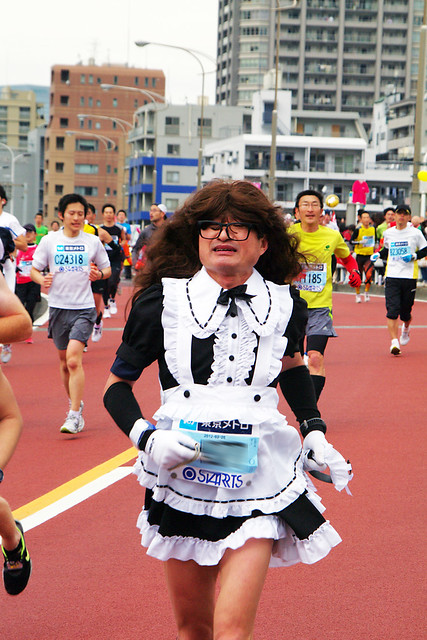
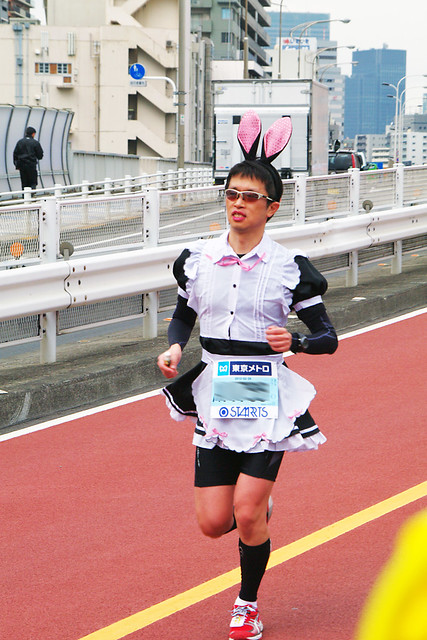
COSTUMES FROM THE TOKYO MARATHON

The Tokyo Marathon, which takes place in February, is as much a testament to fashion as it is to fitness.  In addition to those runners attired in traditional shorts or tights and sweat-wicking fabrics are men and women in creative getups ranging from silly hats to full-body costumes.  As I look through the pictures, all admiration is banished by the persistent question: How do people run in this stuff?

Here are some highlights.  

The completely impractical:
From suradiolive.com
The lightsaber is a nice touch.  From archive.rebeccablacktech.com
From blogs.wsj.com
The guy with all the Apple gadgets:
From www.macworld.com.au

Traditional Japanese clothing:
From uk.eurosport.yahoo.com
From ani.me

Cross-dressing: 
From www.corbisimages.com
From www.flickr.com
From www.flickr.com
And the blasphemous: 
From http://goyrepublicezine.blogspot.jp
From http://www.flickr.com
Congrats to Dennis Kimetto and Aberu Kebede, winners of the men's and women's races, respectively!  Both wore standard running togs.  

Sunday, February 17, 2013

SHAME, SEPPUKU, AND JAMES BOND

GOMEN

And now for a scandal that has rocked the world of Japanese pop music.  Recently a member of girls group AKB48 named Minami Minegishi was found to have a boyfriend, in direct violation of her contract.  To make matters worse, she was caught embarking on a  walk of shame from her boyfriend's apartment early one morning.  Hours later, she did what any penitent person in the public eye would do: she shaved her head and issued an apology on YouTube.  She shaved.  Her head.  


Minami's coiffure in better days.  From www.news.com.au
She's really, really sorry.  From abc.go.com
This may seem old hat to some who remember a similar stunt performed by Britney Spears a few years back.  What sets Minegishi apart, however, is that her new 'do is not an act of rebellion, but rather of abject shame.  Which just goes to show that Japanese guilt surpasses any other kind, whether white, Jewish, or Catholic.  Sure, the Catholics have hair shirts and self-flagellation, but those pale in comparison to practices like seppuku, a form of ritual suicide popular in the days of the samurai.  Perhaps the most famous tale of seppuku is that of the 47 ronin from the early 18th century.  Ronin are samurai who have lost their masters, and by some interpretations of bushido (the samurai code of conduct), the death of a master was reason enough for a samurai to commit seppuku.  However, the 47 ronin are infamous for having avenged the death of their master, and then committed seppuku as punishment.  Their actions came at a time when the chivalrous values of the samurai were perceived as disappearing, and so a mass demonstration of faithfulness to bushido garnered a great deal of notoriety and respect, with the burial place of the 47 ronin becoming an almost sacred site.  Today the legend lives on, and this year "47 Ronin," a movie starring Keanu Reeves, will be released.  Because clearly there is no greater way to honor these fallen heroes, these mythical figures, than by having one of them portrayed by the enigmatic Keanu Reeves.   


From keanulover.wordpress.com
In modern times, seppuku has become mostly a thing of the past.  However, there are still instances of seppuku being employed as a form of political protest, most recently in 1970 against the Japanese government.  A businessman also committed seppuku in protest of a corporate restructuring in 1999.  These incidents are sad, not to mention scarring, even in an age where violent media abound.  However, it's clear that in Japan, a simple apology for transgressions will not suffice the way it might in the western world.  There must be atonement and sacrifice, whether it's forfeiting your own life, or being humbled by a buzz cut, like Minegishi.  

Minegishi has been relegated to the position of "trainee," allowing her to sing and dance another day for AKB48.  Which left me with the big question: what, if anything, happened to her boyfriend?  Minegishi's sweetie, boy band member Alan Shirahama, is still with his group, Generations.  Interestingly, though he has received no official slap on the wrist from his agency (who said his private life was his business), he's endured a lot of flack from Japanese fans, who were distressed that he didn't show more concern for his girlfriend's plight.  This article from The Atlantic highlights the disparity between genders in Japan, saying: 
Minegishi's apology and the idol culture that allowed it to happen are reflections of a Japan shifting more and more to the right, with gender issues especially changing. As people buzzed about this drama over the weekend, Americans focused on their own big musical happening Sunday night. Beyoncé performed during the Super Bowl halftime show, and at one of the country's most traditionally macho events, she wowed with all-women backup and her own charisma and talent, putting on a great show. Japan has had performers like that in the past—pop stars like Ayumi Hamasaki and Koda Kumi, who were fiercely independent and inspiring. But today they lack that. Instead, their pop stars are corralled by the backwards demands of their conservative fans. 
This is particularly interesting when you consider that the most highly regarded western music idols in Japan are women like Rihanna, Lady Gaga, Avril Lavigne and Beyoncé.  None of these women have allowed themselves to be dictated to by their fans, whether in their music or their private lives.  Gaga champions gay rights and wears bizarre costumes; Lavigne earned fame for her angry music and her refusal to look like the nice, sweet girl you'd bring home to Mom or bake cookies with after school.  Rihanna has created the biggest waves lately as she got back together with her ex-boyfriend, Chris Brown, who beat her to a pulp a few years ago.  Back then she was applauded for showing the world what he'd done and ending their relationship, and the fans who supported her in the aftermath are outraged that she's gone back to him.  Their disapproval hasn't deterred her one bit, and she's been seen publicly with Brown, most recently at The Grammys.  This proverbial airing of dirty laundry is almost unheard of in Japan, probably because celebrities stand to lose too much by breaking the rules.  Unlike in the west where scandal can heighten fame and spur someone's career (Kim Kardashian and her sex tape, anyone?), in Japan it can kill it.  And when the transgression is something as relatively tame as having a secret relationship with another consenting adult, ruination seems like a high price to pay. 

GHOST ISLAND

The latest installment in the James Bond franchise, Skyfall, features a scene where Bond is lured to an abandoned island to face his nemesis for the film, played by Javier Bardem.  The location was inspired by Hashima Island, also known as "Battleship Island."  During the industrialization of Japan, the Mitsubishi Corporation bought the island and began digging for coal.  As the endeavor grew, the corporation set up what amounted to a civilization separate from the mainland, with huge concrete apartment buildings, temples, graveyards, markets, schools, etc.  At one point, 5,000 people were living on the island.  That is, until the coal ran out in 1974 and Mitsubishi shut down production.  Workers were told that a limited number of them could find new jobs with the corporation back on the mainland, but they were to be distributed on a first come, first served basis.  Thus, thousands of families scrambled to get off the island as quickly as possible, not bothering to pack their belongings, move their furniture, etc.  The island has been left mostly as it was when people lived there in the 70s, lending an eerie quality to its decay, and prompting the new name "Ghost Island."

This documentary from 2002, though perhaps not award-winning, provides a glimpse into how Hashima Island looks today, and a little about its history.  

Monday, February 11, 2013

SCHOOL LUNCHES

WaPo recently ran what amounted to a love letter to school lunches in Japan.  The highlights: Japanese kids eat some of the most nutritious and best lunches in the world!  Obesity levels are remarkably low in Japanese child and adolescent populations! Parents even seek out recipes to duplicate at home!  And most importantly: if you or your child are not eating Japanese school lunches daily, you should go cry in a corner, because you're probably going to get fat and die young.  Or at least younger than a Japanese person, who will live on average 83 years.  

I should preface this by saying that I have never eaten kyushoku, or school lunch.  Kyushoku ends after junior high school, along with compulsory school attendance.  However, some Japanese people express nostalgia over school lunches, particularly baby boomers, for whom kyoshoku was perhaps their one substantive meal of the day.**  It's also not uncommon to see JETs post photos of their food on Facebook, or giddy status updates like, "OMG it's curry day so excited!!!"  Still, not every meal is a hit, and there is the occasional complaint.  One JET who read the WaPo article posted, "Hey WaPo, my Japanese JHS students hate school lunch and complain about it every day. They'd all rather eat the bento mom will make them every morning."  

Yet some schools, particularly primary schools, ban home lunches.  Bento making has approached an art form, and thousands of websites offer tips on how to make food more aesthetically pleasing.  Of particular importance is how cute the lunch is, and there can be hurt feelings, particularly among elementary school students, if their lunches are not as kawaii as their friends'.  Oh how far we've come from the days (at least in my generation) where kids would proudly flaunt their processed Lunchables snack packs as proof of their mothers' superior love and care.  Now mothers are spending hours upon hours prepping ingredients, cutting foods into shapes, and artistically arranging them for consumption.  

My high schoolers either bring their lunch or buy bread and sugary drinks from the school store.  Teachers can order bentos from an offsite provider; however, this is no a la carte service.  Everyone gets the same lunch.  You want dressing on the side? Too bad. 


Complete with a fried egg in the shape of a heart.
Lotus root (bottom left) is particularly delicious. 
As a foreigner, my lunch is often scrutinized.  Students want to know what I'm eating,  and sometimes even ask for a taste.  The teachers want to know if I prepare my lunch or buy it.  The other day I brought leftover Mexican food (many thanks to my aunt and uncle for sending me the supplies), and one of the male teachers stopped to hover over my shoulder.  After several minutes, I heard him ask the young Japanese teacher near me, "What is that?" Luckily, she had a ready answer, since she had asked me the same question the day before. "Oh," she replied softly, "I think they are...tacos?"  

**Many people think with particular fondness about the days when whale was served.  After the world wars, when Japan was strapped for resources, whale provided a relatively cheap and plentiful source of protein.  Whaling has caused a furor in some western countries, who regard the industry as barbaric.  Older generations of Japanese respond to this censure with indignation; their attitude seems to be, "We did what we had to do, and we ate what we had to eat." Demand for whale seems to be falling nowadays, however, and I've never heard of anyone being served whale at school.  For a more in depth look at whaling, here's an article by journalist Jake Adelstein.  More soon on him and his fascinating book covering the Tokyo police beat in the 1990s.  

LIFE WITH RINO

LAL directed me to a series of YouTube videos titled, "Rino which eats world various dishes." The premise is simple: Rino is about 4 years old, and her mom makes rather elaborate international dinners, which she then feeds to Rino and films her (exuberant) reaction.  If that wasn't adorable enough, her infant brother occasionally makes cameos as well.  

I have to say, I want to hang out with Rino; she's adventurous and she can really eat, which are qualities I look for in my friends.  Her table manners we can work on; she's not even 5, after all.  Plus, her mom is a great cook (watch her flip this giant okonomiyaki, which has natto in it. Props to Rino for eating anything with natto in it)! 

Rino gives me hope in a world of picky eaters, where some kids pass the first 10 years of their lives consuming little more than chocolate milk, and some adults have never eaten something as commonplace as a banana (seriously, I dated someone like that in college).  There's a whole delicious world out there, and Rino's gobbling it up...literally.  Ganbare!